How to Write a Resume for Your First Job
There’s a very good chance your very first job search is going to be a bit overwhelming, especially when you have hardly any—if any at all—experience to showcase. Let me ease that a bit.
First of all, entry-level employers understand that you’re starting out. Second, the real challenge isn’t about trying to seem more experienced than you are. It’s about presenting your strengths, skills, and motivation in a professional, easy-to-read format. This guide will walk you through building a first-job resume that stands out, whether you’re in high school, college, or just entering the workforce. It’ll show you what to include, how to highlight any standout attributes, and the mistakes to avoid.
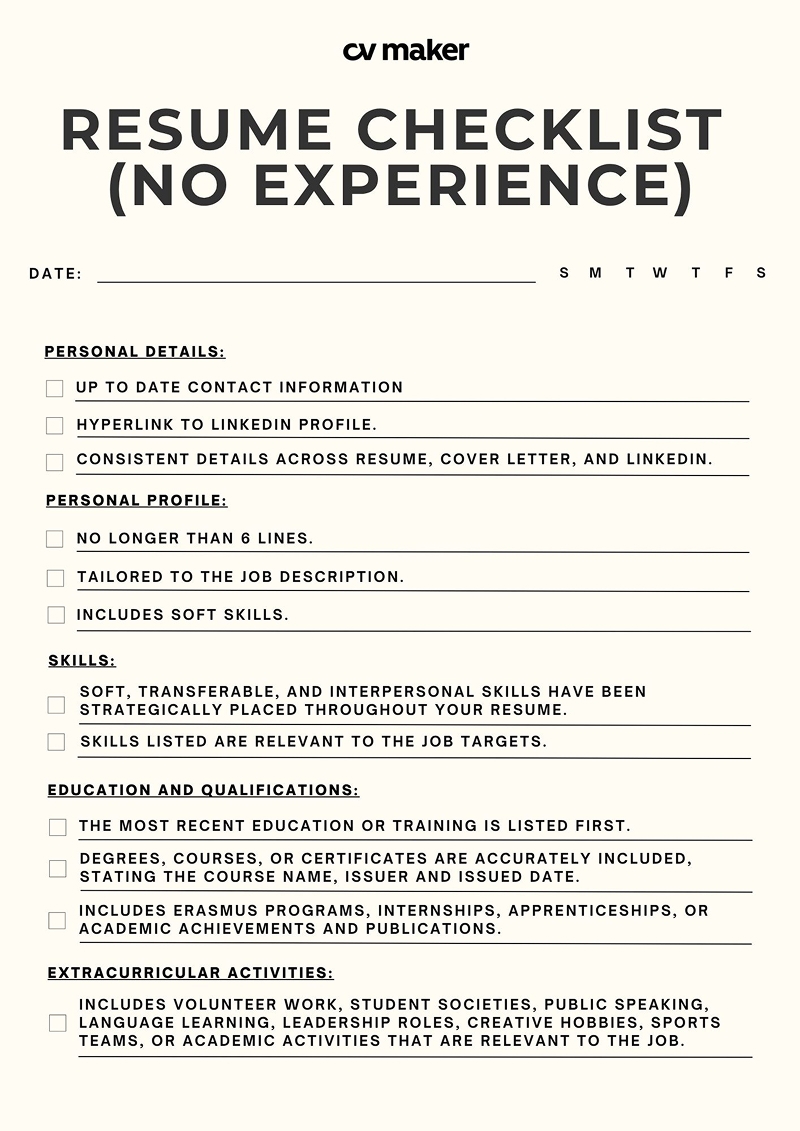
Don't forget to check out our Resume Checklist: No Experience Edition at the end of this article.
Let CVMaker guide you through the CV writing process, offering a professional first resume template to highlight your strengths.
What to Include on a First Resume
Obviously, if you’re writing a resume for your very first job, you have limited experience—at least in the workforce. So you need to focus on whatever unique values you bring as a student, volunteer, or active community member. Your resume should be a snapshot of what you’ve done, who you are, and what you’re ready to learn.
Follow these guidelines:
Contact Information
Start with the basics. At the top of your resume list:
- Your full name
- City and State/Province
- Phone Number
- Professional email address
A cell phone number is better than a landline, but if you do use a landline, it’s probably a good idea to say so. A professional email address doesn’t mean you need a company name, it just means it should be something respectable. You can also add a resume headline. Don’t add personal details like your full mailing address, birthdate, or photo. That may be the norm in parts of the world, but not in the US or Canada, and it will help protect your privacy.
Resume Summary or Objective
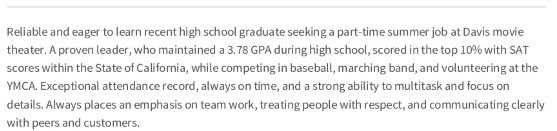
A resume summary or objective is a short, focused statement that’s your introduction to an employer. Think of it as your chance to communicate your enthusiasm and career goals even though you have limited or no real experience. Either way, this section should be tailored to the job you’re applying for.
Here’s an example someone applying for their first job could use:
Your summary should set the tone for the rest of your resume by highlighting your intent and any relevant strengths.
Skills Section
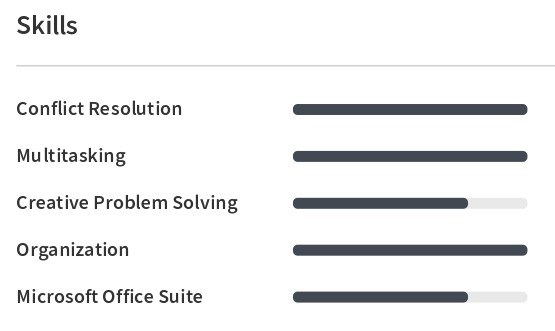
Even if you don’t have any formal work experience, you might still have a range of skills that would be valuable to employers. Divide your skills in your resume into two categories: your technical or hard skills and transferable or soft skills. Then use this section to spotlight any abilities that match the job description.
Here’s what this section should look like:
Hard Skills
- Proficient in Microsoft Office Suite and Google Workspace
- Social media management
- Basic coding (HTML, Python)
- Bilingual in English and Spanish
Soft Skills
- Communication
- Teamwork
- Time Management
- Problem-Solving
Never underestimate your soft skills! They are highly sought after, especially in entry-level job candidates. So be sure to review each job description you’re interested in and match your skills to what an employer is looking for.
Explore the following resume examples and step-by-step writing guides for more inspiration:
- Hospitality resume example
- Administrator resume example
- Computer science resume example
- Customer service resume example
Experience Section
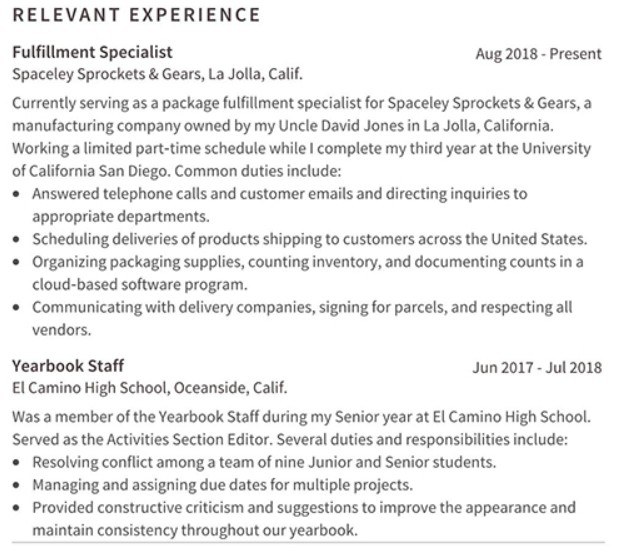
This is the section you’re probably dreading the most, right? But the experience section on a resume isn’t just about paid employment. If you think a little outside the box, you can probably come up with ways you’ve contributed to your community—whether that’s school, church, social clubs, your neighborhood, or whatever—developed leadership abilities, or taken on responsibilities.
If you’ve ever volunteered, organized a club, babysat, tutored, or been a part of a school project, employers will value that. Team sports, music groups, or student government all show you’re capable of commitment, teamwork, and initiative, so don’t sell yourself short.
Use action verbs when you describe your experience, focusing on what you’ve accomplished or learned:
- Organized a successful food drive for the school community, collecting over 500 cans for local families.
- Babysat for three neighborhood families, developing time management and conflict resolution skills.
- Served as yearbook staff photographer, collaborating with a team to meet deadlines and produce quality content.
It doesn’t matter if these achievements seem small. They can still demonstrate a good work ethic and transferable skills.
Education
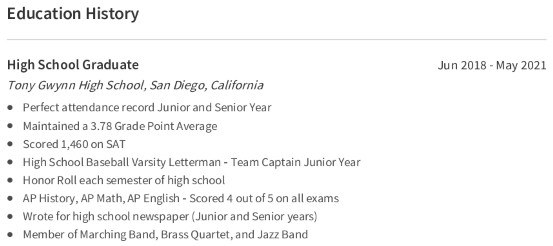
When preparing to apply for your first job, the education section in a resume becomes the foundation. Start by listing the name of your current school, its city and state/province, and, if you haven't already, the date you expect to graduate. If you have a strong GPA, honors, or if you’ve completed any relevant courses, make sure you include them. If you’re in college, you might want to add your major or concentration.
Example:
Lincoln High School, Denver, CO
- Expected Graduation: June 2026
- GPA: 3.7
- Honors: National Honor Society, AP Scholar
If you’ve taken classes, attended workshops, or completed certifications that relate to the job you want. Maybe things like CPR training, coding boot camps, or leadership seminars, add them to your education section or create a separate section called Certifications.
Extra Sections That Can Make You Stand Out
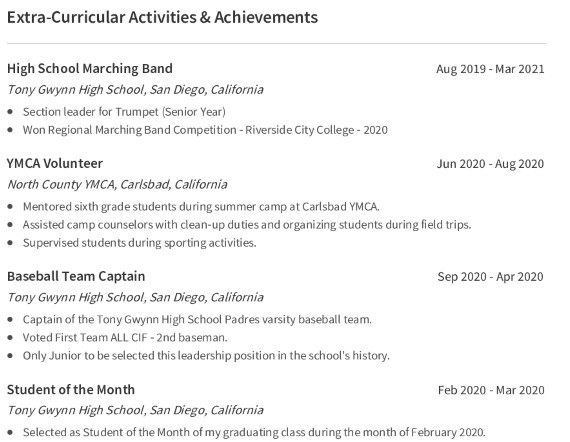
A first job resume is your chance to show who you are and who you can be out of the classroom. So getting strategic and adding some extra sections may help you prove things like initiative, leadership, or any specialized interests that might be relevant.
Here are some things to consider:
- Certifications: Think of things like First Aid, CPR, Microsoft Office, or Google Analytics
- Languages: Add any languages in your resume that you’re fluent or proficient in
- Awards and Honors: Scholarships, academic or athletic awards, or public recognition
- Community Service: Volunteering or participating in service projects
- Extracurricular Activities: Leadership in things like clubs, sports teams, or student organizations
- Hobbies and Interests: Only add interests in a resume that relate to the job or show a level of dedication or skill
Even if an extra section like this is short, it can still have an impact and help you stand out in a stack of resumes that all look the same.
Formatting and Design Tips
When you’re writing a resume for a first job, it’s easy to get hung up on the content, but a clear, professional layout is just as important. Most recruiters spend less than a minute doing an initial pass of a resume, so readability is important. Very important! And it’s not just human eyes you need to think about since many companies and most job sites are using applicant tracking systems (ATS) to screen resumes before they even reach a recruiter.
ATS is looking for keywords, section headers, and formatting it can read. If you use complicated layouts, tables, images, or non-standard fonts, it might confuse or misinterpret your resume and ultimately delete it. So always use standard, easy-to-read fonts like Arial, Calibri, or Helvetica, and keep your font size between 10–12 points for body text and 14–16 points for section headings. Never use bright colors, graphics, or text boxes, stick to black text and, if you must, a single accent color for section titles.
Best practices:
- Stick to a single page, especially if this is a resume for a first job
- Set margins to one inch on all sides
- Align text to the left for better readability
- Use headings to create logical sections
- Balance short paragraphs with bullet points
- Do not use columns or tables
Save and send your resume as a PDF unless an employer requests a different file type.A PDF will keep your formatting across devices. However, make sure that the PDF is ATS-friendly, and don’t use print-to-PDF tools that just convert your resume into an image.
If you’re in doubt, remember that simpler is better. A straightforward, well-organized resume will give you a better chance of making it past round one than something non-standard or unique.
What Counts as Experience for a First Resume?
Experience is a very broad term, so don’t be too narrow when trying to figure out what qualifies. If an employer is hiring for an entry-level position, they’re probably not looking for someone who qualifies as a rocket scientist. They know there’s a good chance you may not have had a formal job, so they’ll look for transferable skills that you developed somewhere else.
Experiences you can include:
- Babysitting, pet sitting, or lawn care services for for neighbors or family friends
- Volunteering at local non-profits, food banks, animal shelters, or community events
- Coaching or refereeing for youth sports leagues
- School clubs, student council, or honor societies
- Organizing fundraisers, events, or school projects
- Freelance work like tutoring, helping with a family business, or graphic design for local groups
The goal is to somehow show that you have a sense of responsibility, commitment, and initiative. So don’t be afraid to include anything that has helped you grow.
Sample Resume Templates For a First Job
Now that we’ve discussed the elements, a visual of how it all comes together will help—at least for you visual learners. Each of the resume examples below will be good for a first job, demonstrate a slightly different approach, and be tailored to different types of students and experiences.
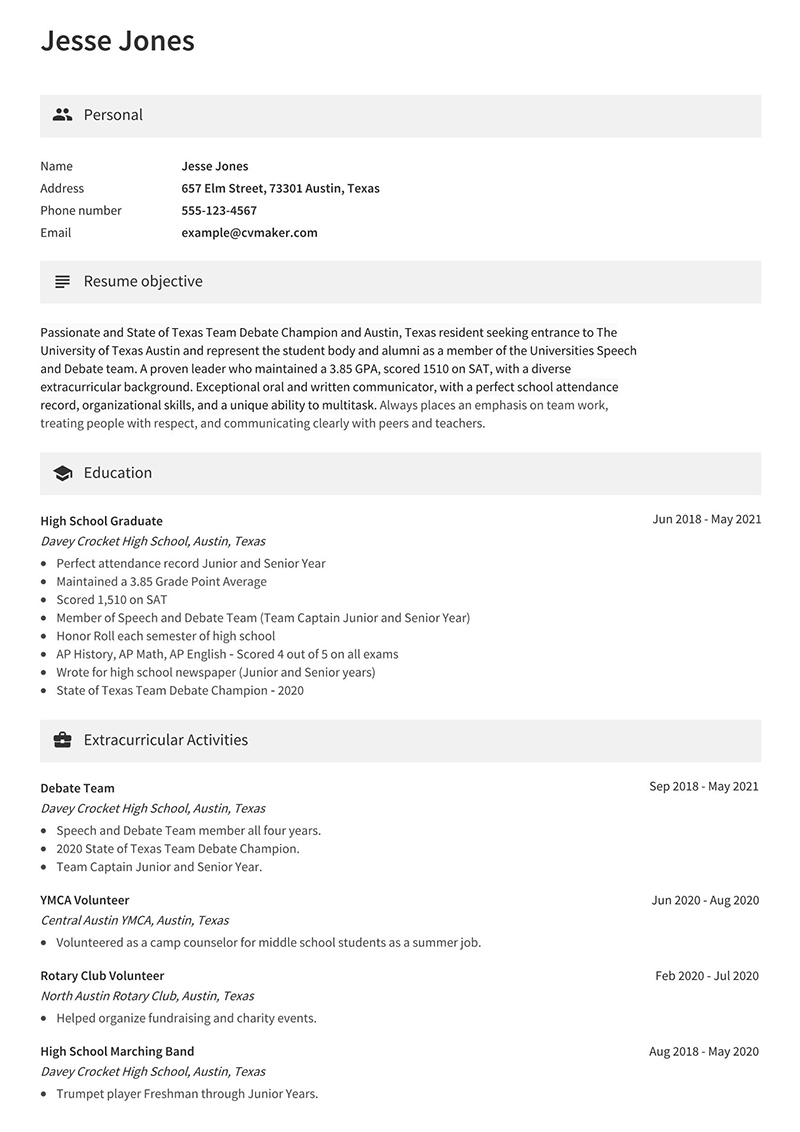
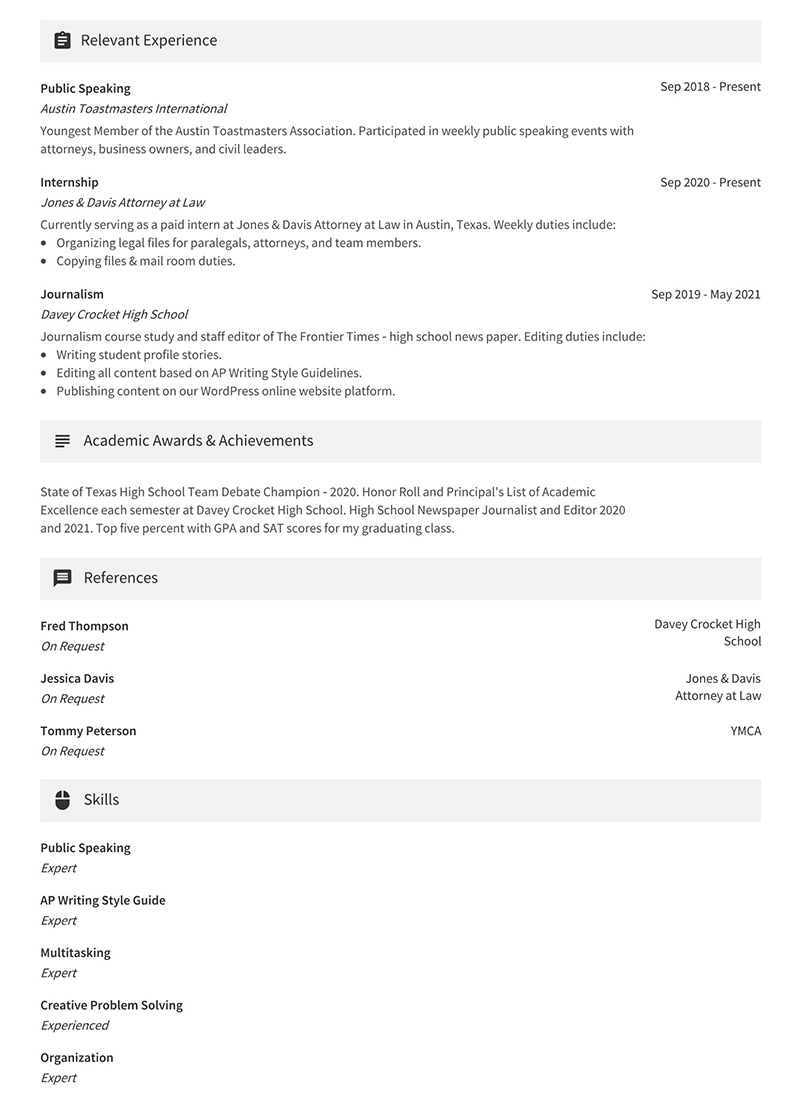
High School Student Resume
This format will put your education front and center, highlight any extracurricular activities, and showcase leadership roles or volunteer experience.
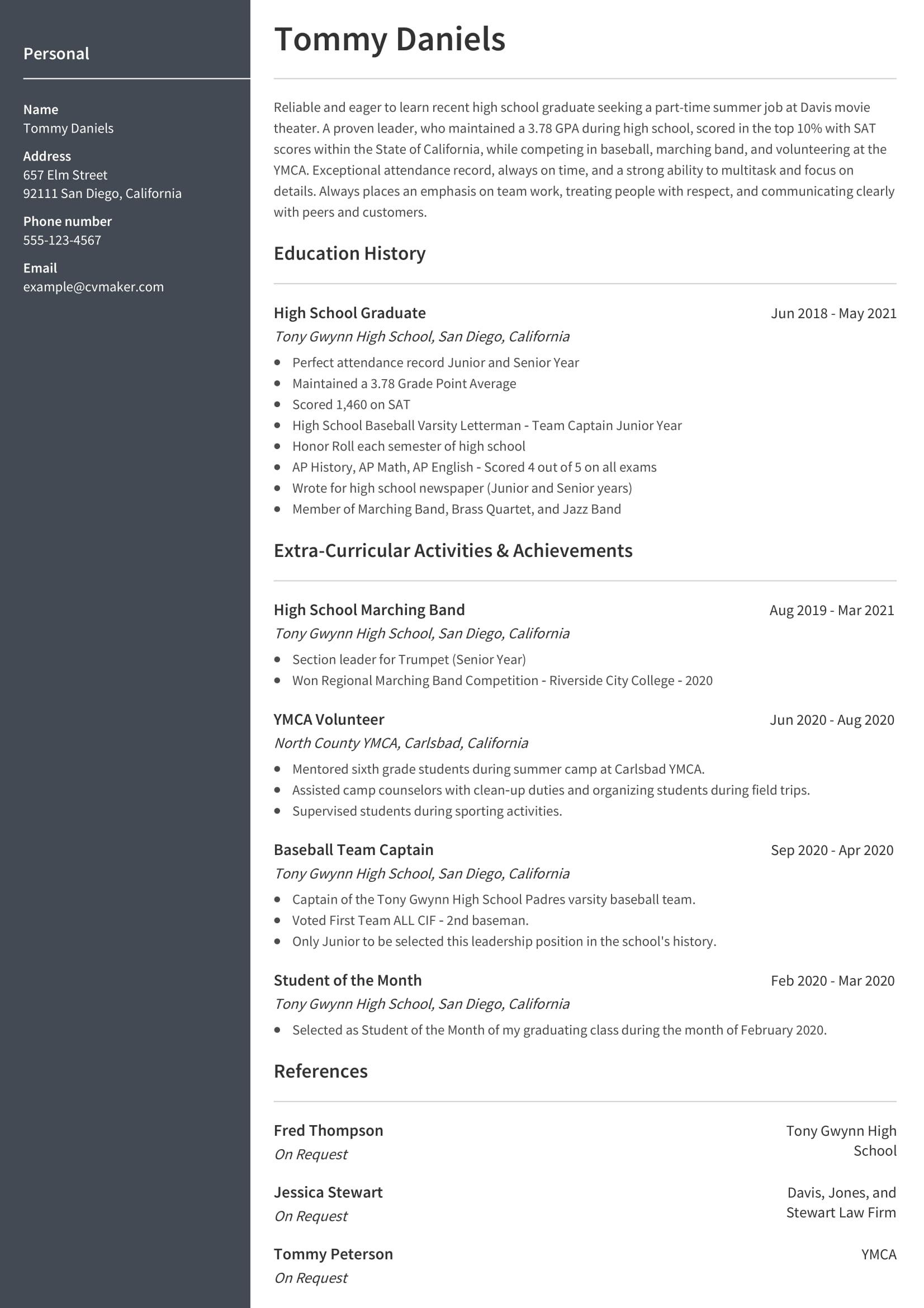
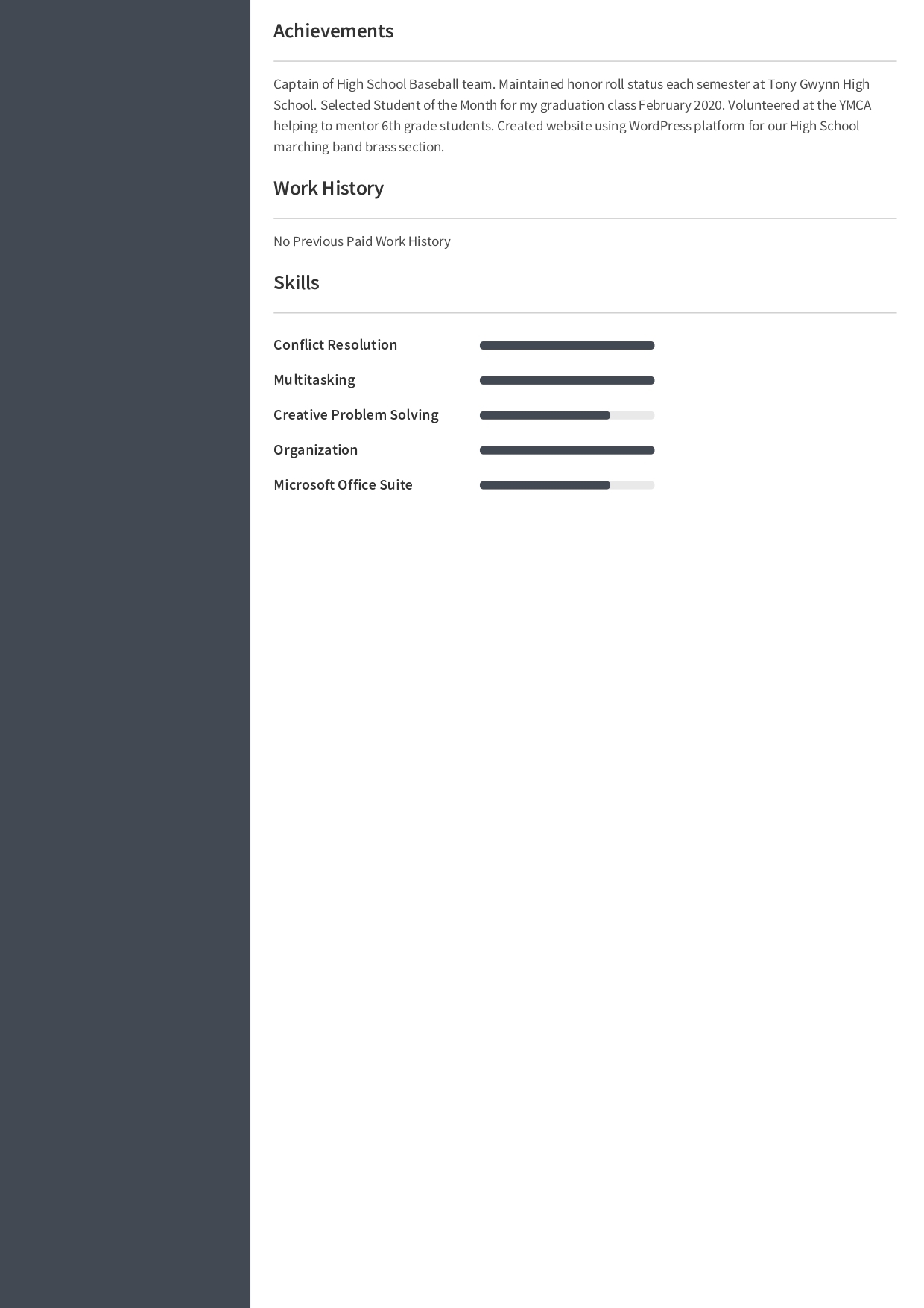
Download this student resume example for free in PDF
College Student or Recent Grad Resume
This is designed for anyone with a mix of academic, part-time, or internship experience. It’s a nice balance of education and hands-on work.
Download this recent grad resume example for free in PDF
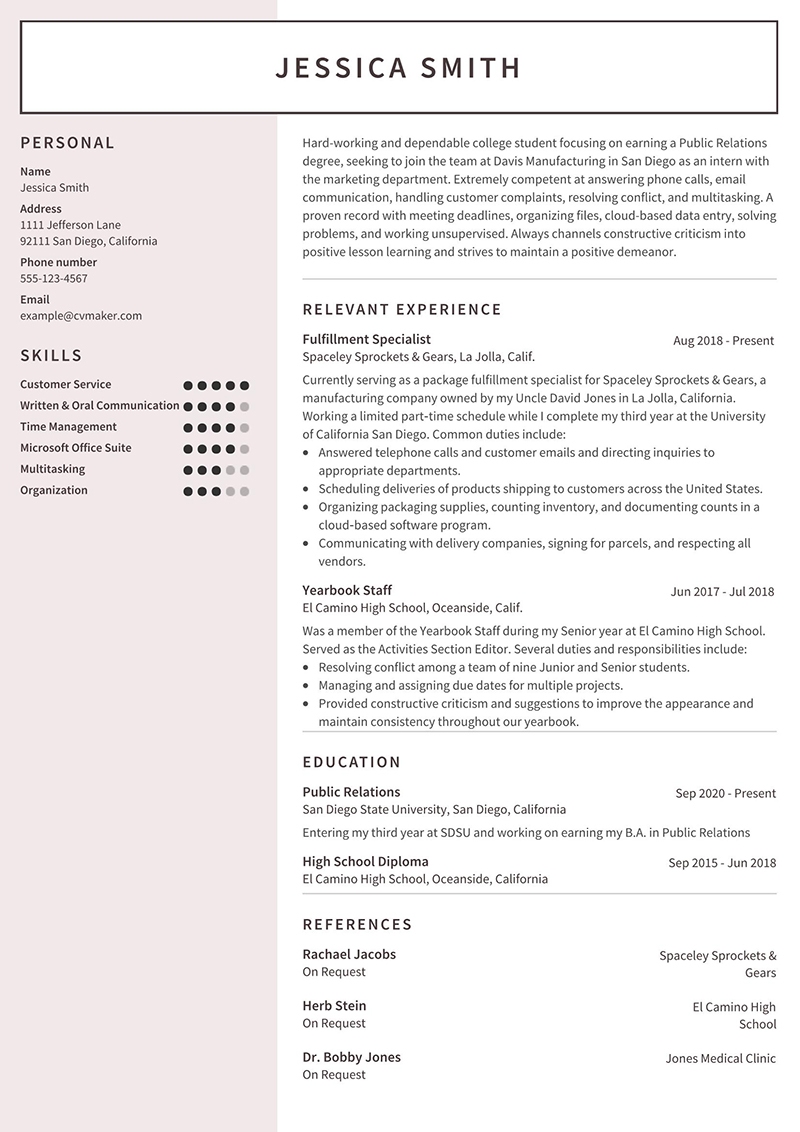
First Internship Resume
This sample focuses on your academic achievements, technical skills, and team projects. It’s the perfect format for anyone looking for their first professional job in a specific field.
Download this internship resume example for free in PDF
Explore the following resume examples with step-by-step writing guides for more tips:
Tips for Writing a Resume With No Experience
So how do you write a resume for your first job—one that will actually help you land a job? It might not be an easy task, but it’s also a good opportunity to focus on your potential and your motivation.
Here are a few strategies:
- Always lead with your strengths. If you are or were a strong student, highlight your grades, awards, or any relevant courses. If you’re active in your community, showcase your leadership or collaboration skills.
- Be specific and action-oriented. Always use active language to describe what you’ve accomplished, even if it’s a small role. Organized, launched, helped, or managed are all strong choices.
- Tailor for your first job application. If this is for your first job, be especially careful to review each job posting you apply to and adjust your resume to match the most important skills and requirements for each.
- Proofread, and then proofread again! Leaving behind typos and grammatical errors sends a message. A message that you’re careless, and that’s not a person employers are looking for. If you’re not confident in your own ability, ask a trusted adult or teacher to review your resume before you send it.
Learn more about how to write a resume without experience.
Common Mistakes to Avoid
Even the best resume can be undone by a common mistake, so stay clear of these:
- Sending out resumes with typos or grammatical errors
- Using an unprofessional email address like [email protected]
- Including irrelevant, outdated, or overly personal information
- Relying on generic terms like “hard worker” without giving examples
- Stuffing every possible activity onto the page—quality matters more than quantity
- Forgetting to tailor your resume for each specific job
Pay attention to your first resume and every single one after that. Just a little bit of attention to detail can separate your resume from every other resume.
How to Get Your First Job: Beyond the Resume
Your resume is your ticket into the job market, but to get your first job, you’ll need to be persistent and resourceful. Don’t just rely on job boards because they have tens of thousands of eyes on each position. Narrow your field—and the number of eyes—to local businesses, community centers, schools, and even family friends, anyone who may have or know of opportunities that aren’t posted online. Let everyone in your network know that you’re looking for work.
Campus career centers, job fairs, and guidance counselors are great resources for students, so take advantage of them. Many schools and organizations often post part-time or seasonal job openings on their websites or bulletin boards, so that’s another place to look. Finally, keep an open mind. Chances are your first job won’t be a dream job, but every position provides you with valuable lessons and potential new connections.
Resume Checklist: No Experience Edition
Conclusion
Writing your first job application or resume is a pretty big deal. It’s a milestone. And while you might not have a long job history, or any job history, you likely have experience, skills, and enthusiasm that employers will value. Take whatever time you need to think about your strengths, present them honestly, and keep your resume clear and focused. Remember, everyone starts somewhere.
Next steps?
Once you’ve explored our application letter examples and templates for any position to craft a compelling letter that introduces your skills and ambitions, make sure your resume reaches recruiters the right way by following our guide on how to send your resume by email. Finally, use our average salary insights in the US to help manage your expectations and have a better understanding of offers you might receive.
FAQs
What can a 15-year-old put on a resume with no experience?
Even if you’ve never worked a traditional job, you probably have plenty to include on your resume. Focus on volunteer work, extracurricular activities, sports, or helping out with family or neighborhood tasks. Emphasize skills like reliability, teamwork, and communication.
What's the best resume format for a first job?
A simple, one-page resume that’s clean and easy to read is best for anyone who’s an entry-level applicant. Put your contact info and a short summary at the top, then your education, a skills section, and finally your experience. Use extra sections like certifications, languages, or awards—anything that’s relevant to the position. The right resume format is the key to being noticed.
What should I not put on my resume?
Avoid personal details other than your basic contact info. Never provide your street address, age, Social Security Number or Social Insurance Number, photo, nationality, gender, marital status, etc. Skip any negative work experiences you’ve had, reasons for leaving past roles, or unrelated hobbies. Don’t lie or exaggerate about any skills or experience.
What are the 3 C’s of a resume?
They stand for Clear, Concise, and Consistent. Your first resume—all of your resumes—should be easy to navigate and understand. It should get right to the point of what’s most important, so skip the filler. Finally, follow a uniform style so every section flows smoothly.
What resume mistakes should I avoid?
- Typos and poor grammar
- Complex or crowded layouts
- Using one generic resume for every job application
- Leaving off important contact info
- Including too much or too little detail