Model Resume Examples, Templates, and Writing Guide for 2026
A model resume is a one-page document that summarizes your physical stats, modeling experience, training, and skills so agencies and clients can quickly assess whether you’re a fit for a specific job. Unlike a standard resume, it headlines your measurements and links to a comp card or portfolio—or both.
This guide will give you real model resume examples including fashion, commercial, fitness, and beginner, access to a model resume template, and a step-by-step breakdown of each section of the resume. Whether you’re submitting to an agency or directly pitching a brand, you’ll learn what to include and how to format it.
Model resume at a glance:
- A model resume starts with physical stats, not work history
- It pairs with a comp card and online portfolio link, which carry your visuals
- Tailor it depending on your type of modeling: fashion, fitness, commercial, and promotional, since each resume emphasizes something different
- Keep it to one simple page and make sure it’s ATS-friendly
- Refer to the examples below and the writing steps for all the guidance you need
What Is a Model Resume?
A model resume is a short, structured snapshot of who you are as a working model. It tells an agent or casting director your physical measurements, the type of work you’ve done, and the skills you bring. All in a format they can scan in under 30 seconds.
It’s different from a standard resume in two big ways. First, your physical stats come before your experience since your height and measurements are often the deciding factor. Second, this type of resume doesn’t standalone; it’s part of a package that includes your portfolio and comp card, your visual proof.
Why Your Resume Matters as Much as Your Portfolio
Your portfolio shows how you look. Your resume shows how you work. And casting decisions rely on both. A strong look is only the first step; it’s your resume that tells the client or agency that you’re reliable, trained, and easy to direct. Those are the things that get you hired and get you repeat work.
Agencies juggle hundreds of talent submissions, and the model whose stats, experience, and contact details are clearly laid out on their resume is the one who gets shortlisted. Your resume is the connection between your face and your professionalism.
Your Master Resume
Think of a master resume as a behind-the-scenes document where you keep a record of every job, achievement, skill, and detail from your modeling career so that nothing gets lost or forgotten about over time. Unlike your real resume, it’s for your eyes only, so keep everything, even credits that might seem irrelevant now, because they may be useful be in the future.
Keeping a master resume means that when opportunities come up, you’re not always starting from scratch.
Model Resume Examples
Fashion Model Resume Example
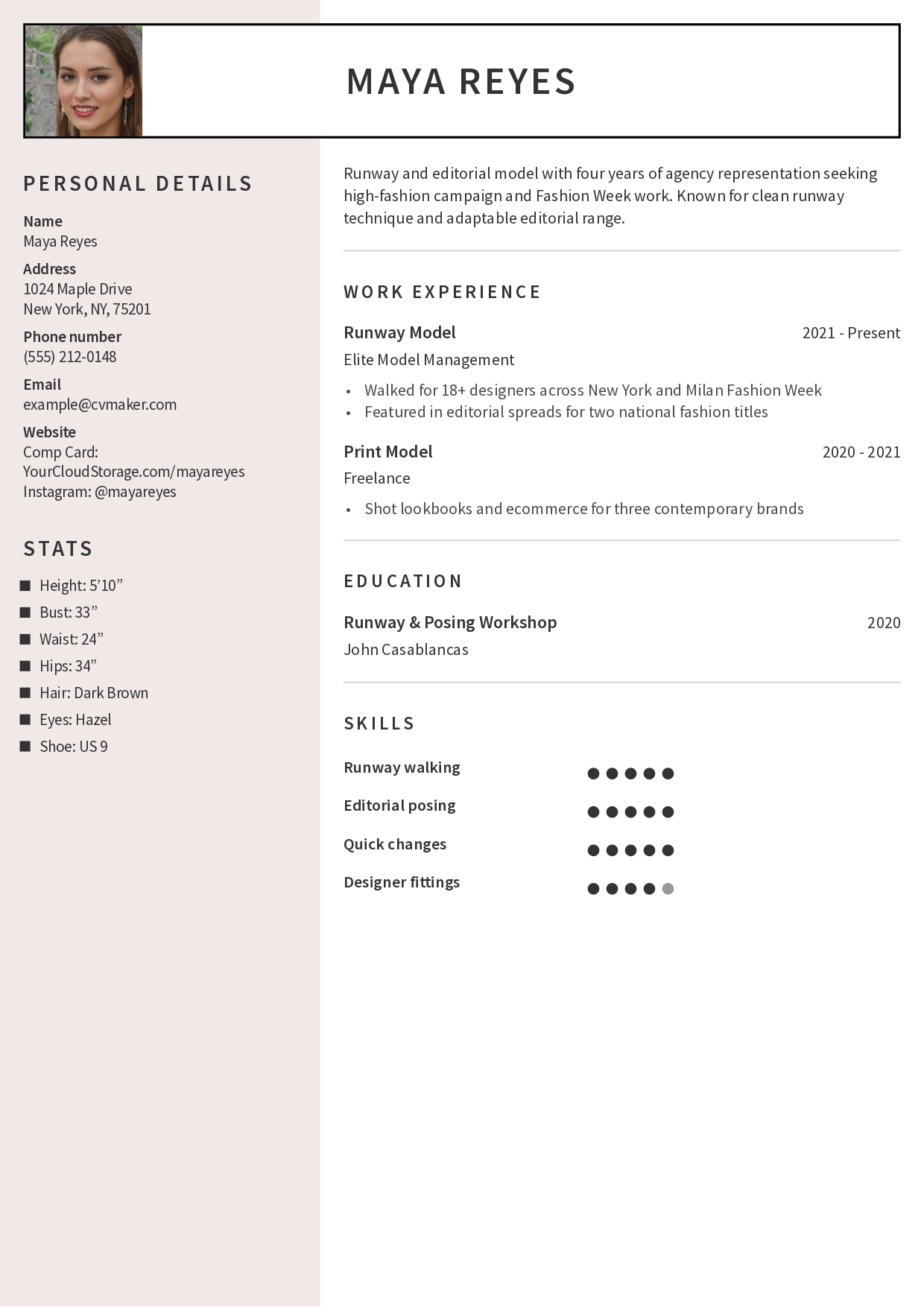
Download this model resume example here
Why it works:
Commercial Model Resume Example
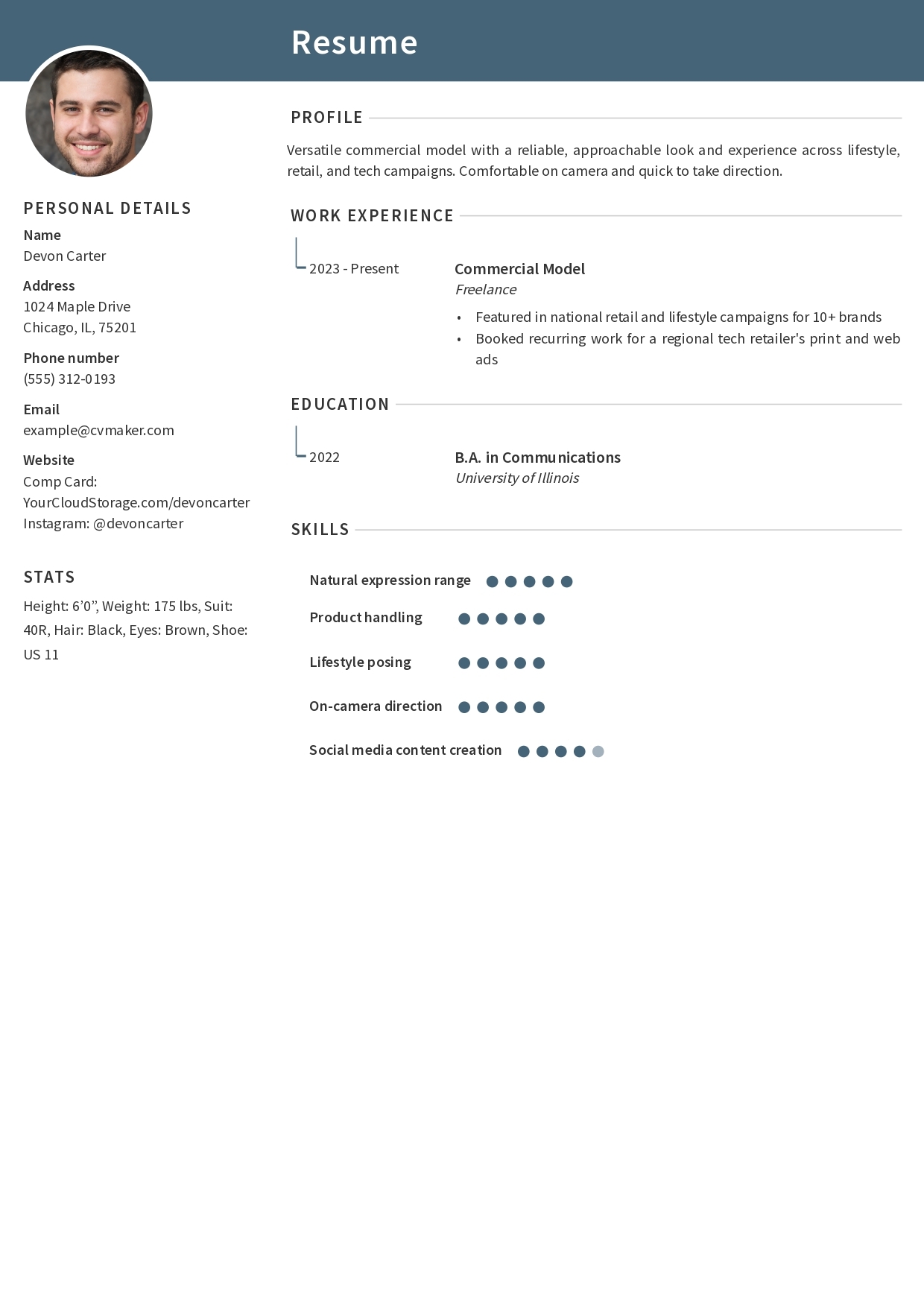
Download this model resume example here
Why it works:
Fitness model resume example
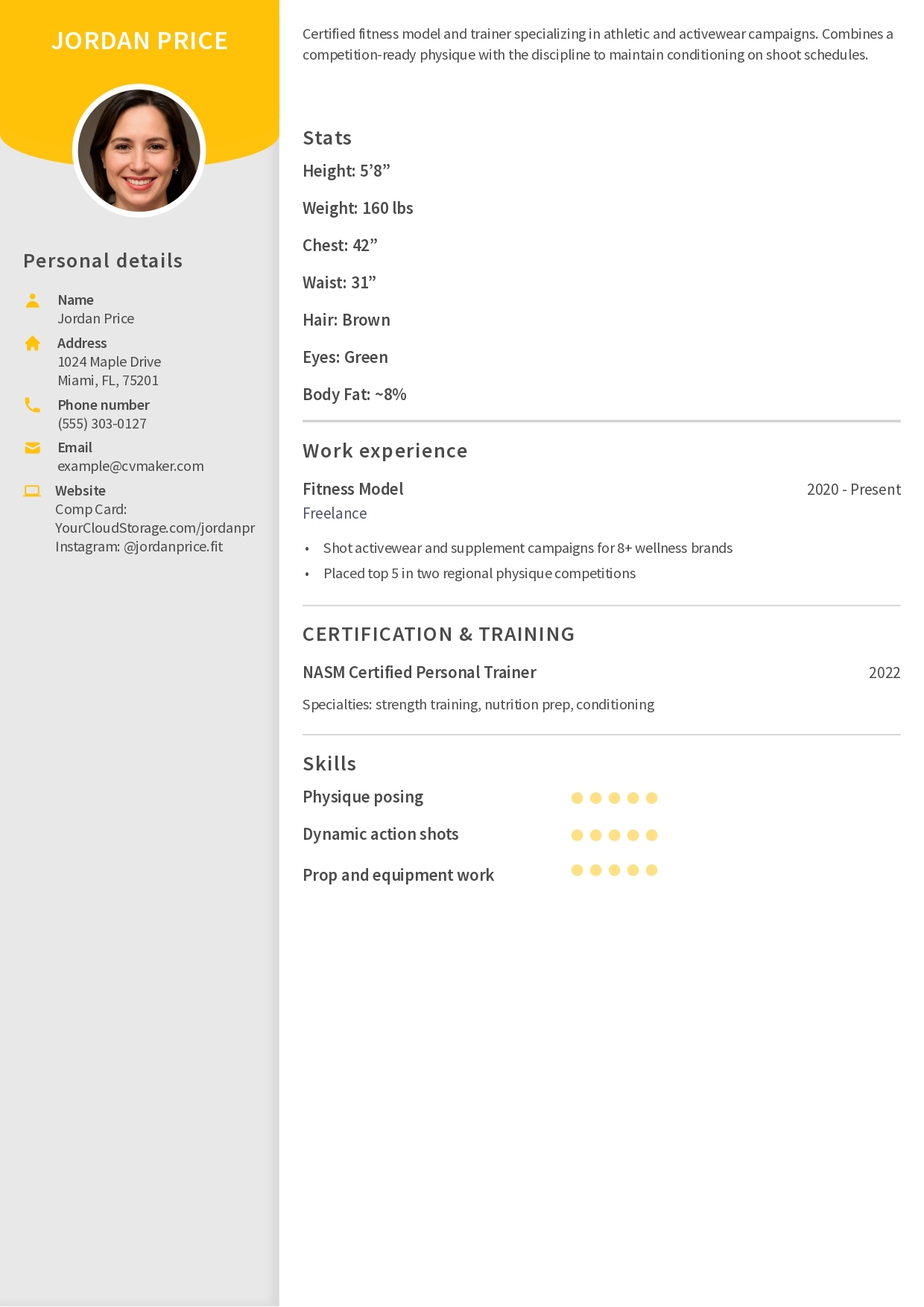
Download this model resume example here
Why it works:
Beginner Model Resume (No Experience)
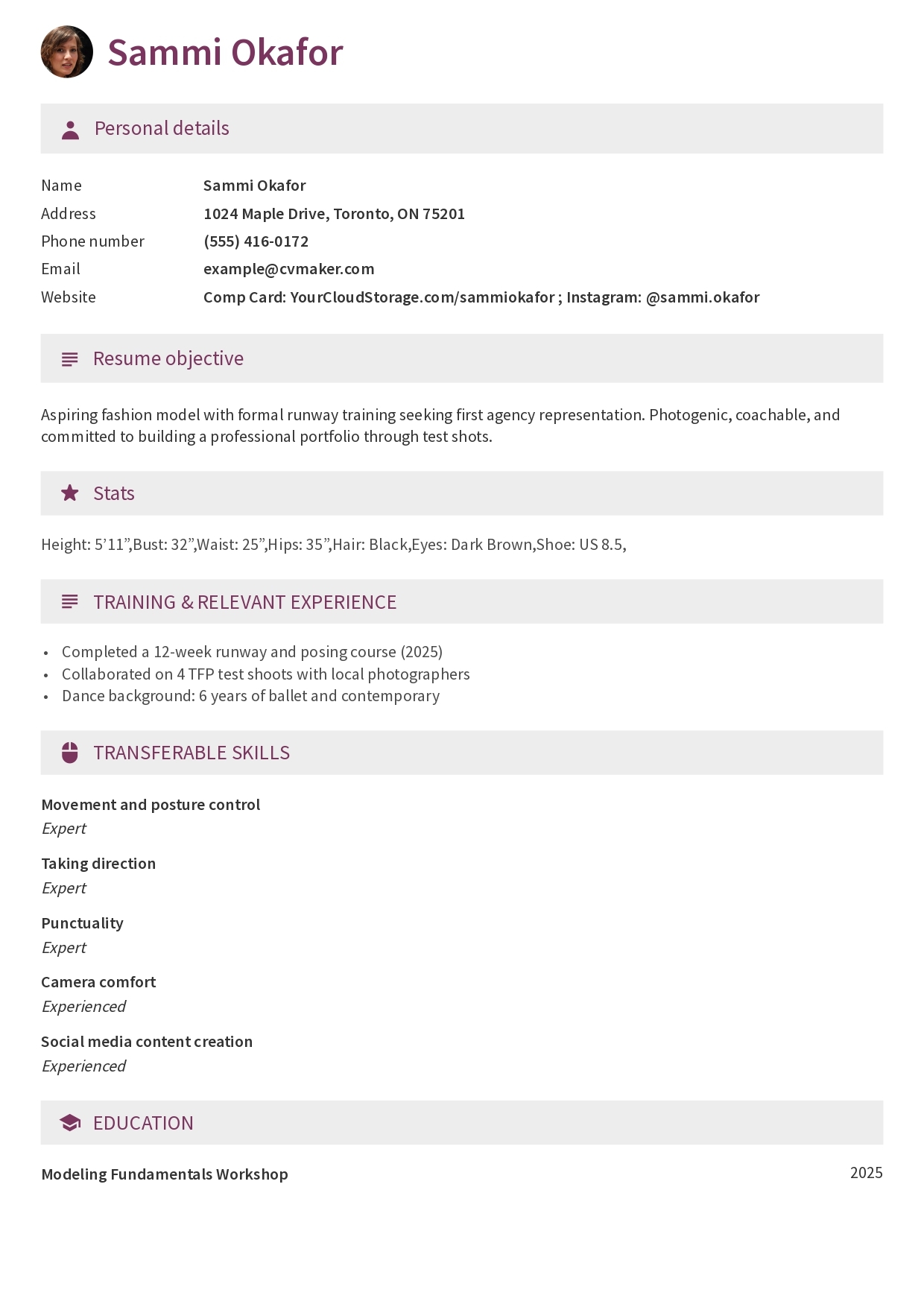
Download this model resume example here
Why it works:
How to Write a Model Resume Step by Step
Step 1 — Contact Information and Physical Stats
Like any resume, adding your contact info is straightforward. Provide your name, phone number, email, and city/state. Don’t add your full street address. Location does matter for casting radius, but a specific address isn’t necessary and shouldn’t be shared for privacy reasons.
Physical measurements are where a model resume diverges from any other resume. Clients and agencies expect to see your stats upfront so they can match you to a brief before they even open your portfolio. Always list the following:
- Height and weight
- Bust/chest, waist, and hip measurements
- Eye color and hair color
- Shoe size, and if relevant, add dress or suit size too
Although you need to add them all, the stats that really matter will depend on your niche. A fashion resume should prioritize height and bust/waist/hip measurements. Fitness resumes often add chest, arm, or body composition figures. Commercial resumes can lean more to look and sizing instead of measurements. Regardless of the niche, report everything honestly, because your measurements will be verified.
Example
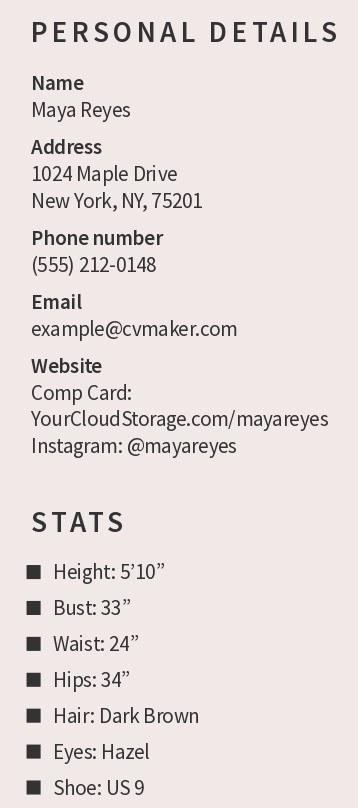
Why this works:
Step 2 — Resume Objective or Summary

A model resume objective is two to four sentences that tell who you are and what your goals are. A generic description of yourself won’t cut it, so here are a few examples you can adapt.
Beginner Example:
Experienced Example:
Can you see the difference? The beginner version uses action-oriented language about training and goals, while the experienced version focuses on quantifiable achievements and named representation.
Step 3 — Work Experience
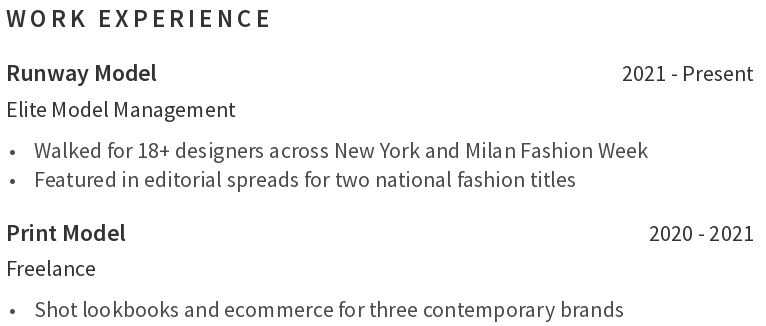
List your modeling work in reverse chronological order, with the most recent first. Each entry should name the role, the agency or client, the dates, and a couple of bullet points that quantify what you did. Here’s the format:
Example
Runway Model | XYZ Agency | 2022-2024
- Represented 12+ designer brands across New York Fashion Week
- Collaborated with editorial teams on 30+ commercial shoots
In that example, numbers are used to do the heavy lifting. There’s no forgettable wording like worked with many brands. Saying 12+ designer brands is concrete and credible.
One thing that’s worth pointing out, though, is that your resume should shift slightly depending on the recipient. If you're submitting to an agency, you'll be evaluated as a long-term talent. So emphasize your range, trainability, and the breadth of your experience. But when you submit directly to a client for a specific job, tailor your experience to that brief. A swimwear brand will want to see swimwear and lifestyle work near the top, not an editorial archive.
Step 4 — Skills
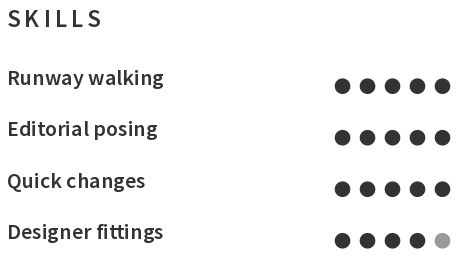
Skills tell clients how you work. Split them into two scannable sections so they’re easy to read at a glance, and then weave in the strongest modeling skills for a resume keywords naturally instead of padding the list.
Pick eight to ten skills that genuinely describe you. A short, honest list will always beat a long list you can’t back up.
Example
Technical (Modeling & Industry Skills)
- Runway walking
- Editorial Posing and styling
- Commercial & lifestyle expressions
- On-camera comfort
- Social media content creation
- Comp card preparation
- Fitness & athletic posing
- Wardrobe coordination
Soft (People & Professional Skills)
- Reliability
- Communication
- Adaptability
- Confidence under pressure
- Coachability and teamwork
- Time management
- Attention to detail
- Poise and professional attitude
Why this works:
Step 5 — Education

Education is optional on a model resume, but if you have relevant training, you should add it. List any modeling workshops, runway and posing courses, acting classes, or fitness certifications—if relevant. Academic degrees really don’t matter unless they’re something relevant, like a communications degree, which would support on-camera promotional work. Keep the section to no more than a line or two.
Example
- Barbizon Modeling & Acting School: Runway, Posing, and Print Modeling Certificate, 2024
- UCB Improv Theater: Intro to Acting for Commercials. 2025
- NASM Certified Personal Trainer, 2025 (for fitness models)
Why this works:
Step 6 — Awards, Publications, and Additional Sections
If you’ve been featured in a publication, won or placed in a competition, or earned recognition for something, give it a short, dedicated section. Editorial features and competition placements are strong third-party proof of your ability.
You can also add any other languages spoken, special skills like horseback riding, swimming, martial arts, etc., or a willingness to travel. Add anything that widens the range of jobs you can book.
Example
Awards & Publications:
- Winner, “Next Face of LA” Competition, 2025
- Published in Vogue Teen (May 2025, Editorial “Rising Star”)
- Finalist, American Fitness Model Search, 2026
Additional Skills
- Fluent in English and Portuguese
- Horseback riding (10+ years)
- Certified lifeguard
- Willing and able to travel internationally for bookings
Why this works:
What to Include in a Modeling Resume: A Section-by-Section Breakdown
Use this as a quick checklist when you’re building or auditing your resume.
- Contact Information: Name, phone, email, city/state. Don’t add a full street address.
- Physical Measurements and Stats: Height/weight, bust/waist/hip, hair and eye color, shoe size. Make sure you adjust what you emphasize based on the type of modeling job you’re applying for.
- Portfolio and Comp Card Link: Add a clickable link to your digital comp card and online portfolio, and make sure you add it to the header.
- Resume Objective: This should be two to four sentences about your look, experience level, and the kind of work you’re looking for.
- Modeling Experience and Work History: List your past bookings in reverse chronological order, adding bullet points with anything you can quantify. Make sure you tailor your resume depending on whether you’re submitting to an agency or a client.
- Skills for a Modeling Resume: Try to keep this section tight, providing a list of eight to ten of each hard and soft skills that you will be able to demonstrate.
- Education: You don’t need to add all of your schooling. Add any relevant courses to modeling, plus workshops and certifications. Keep it to one or two lines.
Modeling Resume Skills: What to List
In most cases, you want to add between five and ten hard and soft skills to your resume. Your soft skills should include any transferable skills that would support your modeling work and show your work ethic.
Don’t list skills that aren’t relevant to the type of modeling you’re pursuing. For example, runway walking wouldn’t be included if you were applying to an agency or client who only does commercial modeling, since they focus on print, advertising, and lifestyle campaigns, not high-fashion catwalks.
Here is a sampling of hard and soft skills, not necessarily tied to one specific type of modeling.
Modeling Skills for your Resume:
Hard Skills
- Runway walking
- Posing techniques
- Editorial styling
- Brand representation
- Social media content creation
- Comp card preparation
- Fitness training
- Wardrobe coordination
Soft Skills
- Discipline
- Adaptability
- Time management
- Communication
- Confidence under pressure
- Professionalism
- Ability to take direction
- Resilience
Types of Modeling Resumes
The modeling field splits into several distinct niches, and your resume needs to reflect the one you’re targeting. By tailoring it, you can capture the right attention and the right search results when clients look for your specialty.
Fashion and Runway Model Resume
This is the category with the strictest physical standards. A resume needs to emphasize height, bust or chest, plus waist and hipline measurements. You also need to include your agency representation. Editorial and Fashion Week credits will carry the most weight, and having a clean technique is a strong selling point.
Commercial Model Resume
The job of a commercial model is to sell relatability across retail, lifestyle, tech, and product campaigns. That means your resume needs to show your versatility, range of look, and brand work instead of adherence to rigid measurements. Your on-camera comfort and ability to take direction are much more important for this type of work.
Fitness Model Resume
Obviously, you have a clear focus here. Build your resume around your conditioning and athleticism. Your resume should list your body measurements—body composition is also a good idea—fitness certifications, training specialties, and any competition placements. In this field, clients don’t just hire based on physique; they also want to know you’re disciplined enough to maintain it.
Acting and Promotional Model Resume
Promotional and acting models work events, brand activations, and often work in spokesperson roles. In this case, a resume needs to highlight your personality, communication skills, languages, and any on-camera or live-audience experience. Your reliability and how you present yourself will matter as much as your look.
Modeling Resume Format and Design Tips
Now that you know everything you need to know about what to include in your resume, let’s talk about how to present it.
Should a Modeling Resume be ATS-Friendly?
It might be tempting to assume that someone hiring for a creative role would skip the gatekeepers—and they might have at one time—but that isn’t the norm anymore. A lot of agencies and brand casting calls collect their submissions via digital portals that screen with ATS (applicant tracking systems) or some kind of automated filter.
That means that even though your career is a visual one, you still need a clean, machine-readable resume. Follow these rules, and you’ll be good to go:
- Keep the format simple. That means no tables, text boxes, or graphics in the resume itself—they belong on your comp card and portfolio anyway.
- Use standard section headings so the system can parse them properly.
- Make sure it’s keyword rich. Not sure where to find your keywords? If you’re replying to an ad, the first place is the job posting. Otherwise, include the modeling skills and niche terms that a casting brief might search for.
- One short callout or summary section is enough. Don’t overdo it.
All of your visuals live in your portfolio and comp card. You want a resume that can be parsed cleanly and read fast.
One Page vs Two Pages
One page is almost always enough. Casting decisions usually happen quickly, and besides, a model resume rarely needs more than a single page. But if you’ve genuinely outgrown a page thanks to years of major bookings, then a second page is absolutely acceptable, just be sure to tighten it up before deciding to expand to the next page.
Cut any old, weak entries instead of spilling over onto a new page.
Choosing the Right Model Resume Template
A good model resume template does all the structural work for you, including the header placement for stats and links, clear section breaks, and a clean, ATS-safe layout.
Pick a modeling resume template that puts your stats and portfolio link near the top and has a minimalist design. Less is always more in this case. Avoid using heavily designed templates with columns and color blocks that could break when being parsed. You can also look into using a resume builder, and find an industry-appropriate template. That’s probably the fastest way to get a polished result that parses well.
Key Takeaways
Lead with your stats, not your history. A model resume puts height, measurements, and coloring before experience since that’s what gets you matched to a brief.
- Always link your comp card and portfolio. Your resume describes your work, but your visuals prove it. Put both links in your header.
- Tailor your resume to your niche. Fashion, commercial, fitness, and promotional resumes all emphasize different stats and skills.
- Quantify your experience. Name the agencies you’ve worked with, and the number of brands you’ve worked with. Real data always beats vague claims.
- List skills you can back up. A tight hard/soft skills split can do a better job of showing your level of professionalism than an exhaustive list could.
- Keep it to one clean, ATS-friendly page. Simple formatting will survive whatever parsing software agencies and clients use, while heavy design often gets filtered to a digital trash bin.
- Choose the right template. A purpose-built model resume will handle the structure so you can focus on the content.
FAQs
What should be on a model resume for beginners?
A beginner resume should include your contact information, physical stats, a link to your portfolio or comp card, an objective that shows you as coachable and serious, and sections for any training, test shoots, and transferable skills. If you don't have any bookings yet, highlight the courses you've taken, any TFP collaborations, and relevant backgrounds like dance or theater.
How do you write a resume for a model?
Keep it short. Start with your contact information and link to your portfolio or comp card. Add a resume objective, work experience, education, and skills. Make sure you tailor it to the type of modeling you do. Keep the layout clean and easy to scan since ATS is now pretty much the norm.
What skills do models need?
List five to ten hard and soft skills so that clients can see what you can do and how you work. Common skills include runway walking, posing, and taking direction on the hard side, plus discipline, adaptability, communication, professionalism, and composure under pressure on the soft side. Only cite skills you can actually backup, because you will be expected to demonstrate them.
Should a model resume have a section about education?
An education section is optional, not required. But the best practice is to only include education that adds something relevant, like modeling workshops, runway or posing courses, acting classes, or fitness certifications. Academic courses and degrees really don’t matter, and experienced models with strong credits can usually skip this section entirely or just keep it to a single line.
How do I highlight awards on a modeling resume?
Awards can help you stand out, so make sure they stand out on your resume. Add them to a dedicated section near the bottom, listing each award and the date you received it. The other alternative is to fold a single, significant award into your objective. Either way, keep it short and sweet.
Should you include a photo in your model resume?
No. There’s a good chance your resume will be rejected at the ATS (applicant tracking system) stage, since the software doesn’t parse images properly and can end up either scrambling your text or hiding some of it. Imagine your contact info getting hidden because you added an image! Your visuals should be in your comp card and portfolio, and you provide a link to that. Your resume should list your physical stats, including height, measurements, hair and eye color, and shoe size.
How long should my model resume be?
One page, almost always. Casting decisions happen fast, so a focused one-pager will work much better than a long, padded two-page resume. Only stretch to a second page if you have years of major bookings that genuinely require a second page, and even then, cut out any weak entries before you expand instead of keeping everything.
Does writing style and layout matter for a model resume?
Yes. Keep it professional, clear, and easy to scan, with standard section headings and no slang. That means proper English—if that is your primary language—grammar and punctuation. Order the sections logically, with your contact info at the top, followed by your objective, experience, skills, and if necessary, education. Use a clean, single-column layout instead of something with a lot of design or multiple columns, since either can break in the automated scanning systems used by agencies and clients to screen submissions.
What physical stats should I include on a model resume?
The standard required statistics are your height, weight, bust or chest, waist, and, for women, your hip measurements as well. Also provide your dress or suit size, shoe size, eye color, and hair color. Providing these details gives agencies or clients a quick overview of your look and whether you fit their requirements.
What is a comp card and do I need one alongside my resume?
A comp card, sometimes called a composite card or zed card, is like a professional business card for models. It usually includes several photos from your portfolio plus your physical stats and contact details. Most agencies and clients expect you to provide both a resume and a comp card, since the card is your visual summary, while your resume only details your experience and skills.
How do I write a model resume with no experience?
If you don’t have modeling experience yet, focus your resume on any related skills or training. That could include things like acting, dancing, or participation in workshops. You can also mention any volunteer or amateur shoots, school fashion shows, or collaborations, as well as your willingness to learn and your professional attitude. Of course, you also need to add your physical stats and a few professional photos.
Should I include my social media handles on a modeling resume?
Yes. Including your social media handles is recommended, but with a caveat. Only include them if they’re public and only if they present you in a professional manner that showcases your modeling work. Instagram is especially important, since agencies and clients will often review your online presence and engagement.
What is the difference between a fashion model resume and a commercial model resume?
A fashion model resume usually highlights work in runway shows, editorial photo shoots, agency representation, and collaborations with high-fashion brands that focus on physical stats and a certain look. But a commercial model resume emphasizes jobs in advertising, catalogs, ecommerce, TV commercials, and lifestyle brands. It can also include skills like acting or voiceover work.
Do I need a cover letter with my modeling resume?
A cover letter isn’t always required for modeling jobs, but having one could be helpful when applying to agencies or responding to casting calls. A short, professional cover letter gives you a chance to introduce yourself, express your enthusiasm, and explain why you believe you would be a great fit for the agency or project.