How to Write a Flight Attendant Resume: Writing Guide, Tips, and Examples
So you’ve decided you’d rather work at 35,000 feet. That’s a great choice! A career as a flight attendant means travel, variety, and a schedule that’s about as far from nine-to-five as you can get. But before you can identify as part of the cabin crew, you need a flight attendant resume that will get you through the door to the plane.
The aviation industry is competitive, and airlines receive thousands of applications. Whether you’re fresh out of school or making a career change from hospitality, your resume needs to show recruiters—and ATS software—that you are who they’re looking for.
This guide will walk you through everything you need to craft a strong flight attendant resume, with realistic examples you can modify for your own application.
Flight Attendant Resume Sample
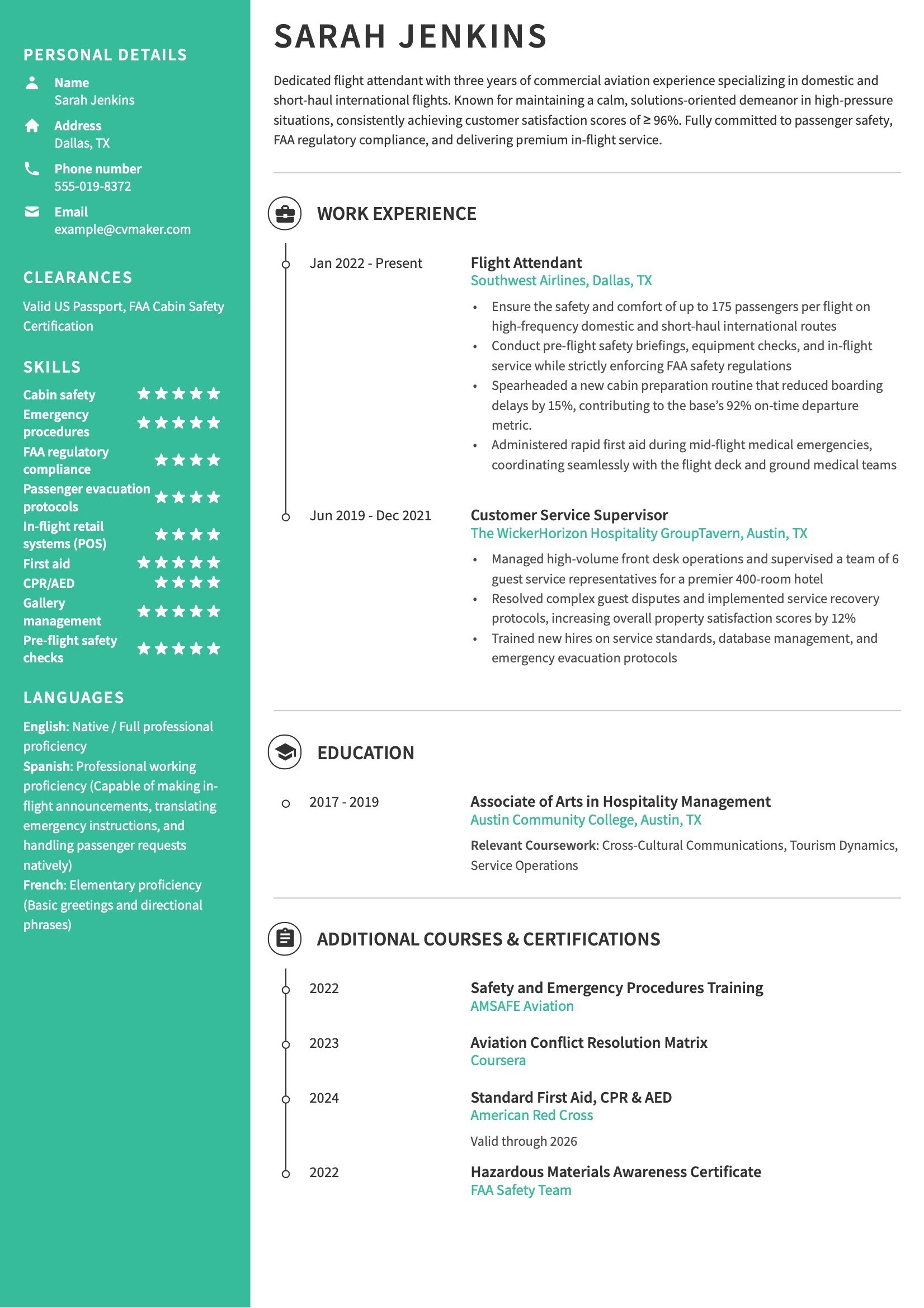
Visual learner? Don’t worry, we got you. Here’s a sample flight attendant resume in PDF.
What to Include in a Flight Attendant Resume
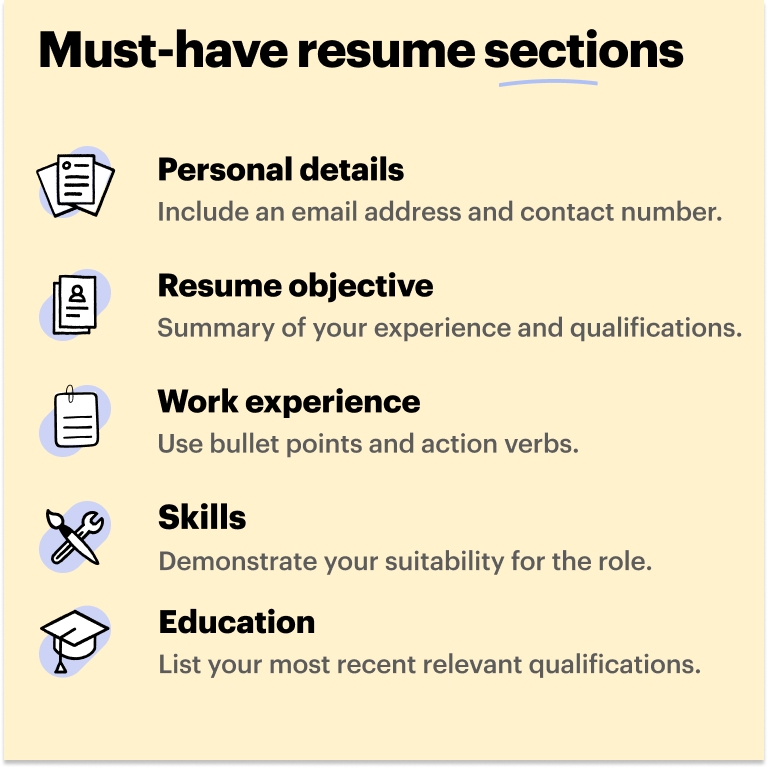
Your resume should give hiring managers a clear, confident picture of who you are and why you’d be the perfect choice for the job. At minimum, they’ll expect to see the following:
- Contact information: Your full name, cell phone number, professional email address, and city or region. Never provide a full street address.
- Professional summary: A short introduction of about 3 to 4 sentences that highlights your experience, strengths, and what you would bring to the role.
- Skills: A mix of hard skills and soft skills—technical and interpersonal.
- Work experience: Relevant roles listed in reverse chronological order. Make sure you list accomplishments, not just duties.
- Education: Your highest level of education, plus any relevant training or courses.
- Additional sections: Certifications, courses, and language skills can set you apart, especially on some international routes.
Keep your resume to one page if you have less than ten years of experience. Two pages are okay for senior applicants with extensive history.
How to Write a Flight Attendant Resume in 5 Steps
#1. Personal Profile Section
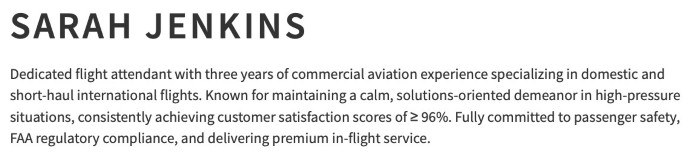
Your resume personal profile—it’s also called a professional summary—sits at the top of your resume, right below your contact information. It’s the very first thing a recruiter reads, and in some cases, it may be the only thing they read if it doesn’t hook them right away.
Think of this section as an elevator pitch. You’re with someone for just a short time and only have a moment to pitch—or sell—an idea to them. You need to get them on board. With your resume, you have about four sentences max to communicate your experience level, strongest qualities, and your enthusiasm for the chance and role. Do not use generic phrases in this section. Never say things like you are a “hardworking team player.” You need to be specific about the kind of environments you’ve worked in, the results you’ve achieved, or any skills that would apply to cabin crew work.
Here are some flight attendant personal profile examples:
Entry-Level Example
Experienced Flight Attendant Examples
Example 1
Example 2
Flight Attendant Supervisor Profile Example:
#2. Skills Section
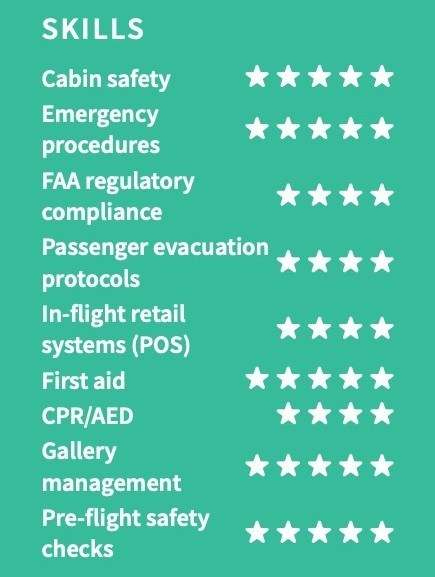
Recruiters spend seconds scanning resumes, and automatic tracking systems (ATS) take even less, so your skills section needs to be easy to read and immediately relevant. It should include a balanced mix of hard and soft skills. Hard skills are your technical, job-specific competencies, and soft skills are an indicator of how you work with people and handle pressure.
Relevant Flight Attendant Hard Skills:
- First aid and CPR/AED certification
- Cabin safety and emergency procedures
- FAA/Transport Canada regulatory compliance
- Passenger evacuation protocols
- Point-of-sale and in-flight retail systems
- Galley management and food service
- Language proficiency (beyond English)
Relevant Flight Attendant Soft Skills:
- Conflict management
- Problem-solving
- Empathy and cultural sensitivity
- Composure under pressure
- Clear verbal communication
- Time management and adaptability
- Customer service orientation
One last tip:
Skills
- Conflict management
- Composure under pressure
Work Experience
If possible, list your skill, and then prove your skill.
#3. Work Experience Section
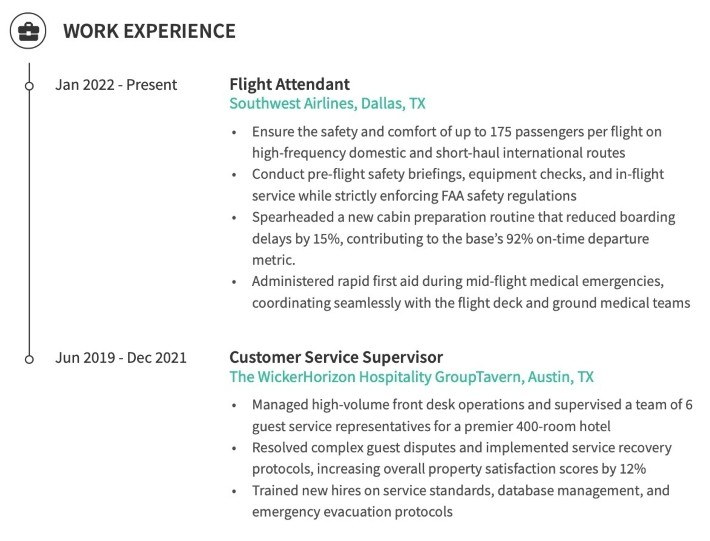
Your work experience section is the heart of your resume. List your roles in reverse chronological order, starting with your most recent position. For each role, include the job title, employer name, location, and dates of employment. Follow that up with a short paragraph that describes your responsibilities, then use bullet points to highlight your accomplishments.
Always use strong action verbs to open a bullet. And wherever you can, include numbers—percentages, ratings, volume of passengers, team size. That’s much more compelling than vague descriptions.
Strong action verbs include:
- Managed
- Coordinated
- Implemented
- Resolved
- Trained
- Achieved
Work experience example - experienced candidate:
Sample #1
Flight Attendant | Delta Air Lines | Atlanta, GA | 2019 – Present
Responsible for the safety and comfort of up to 190 passengers on domestic and international routes. Performed pre-flight safety checks, conducted safety demonstrations, delivered in-flight service, and responded to medical emergency situations in accordance with FFA regulations.
- Maintained a 97% individual customer satisfaction rating across quarterly crew evaluations
- Recognized three times with Delta’s Above and Beyond peer award for exceptional passenger care
- Assisted in the onboarding and mentoring of eight new-hire flight attendants during initial reserve periods
Sample #2
Flight Attendant | Southwest Airlines | Dallas, TX | 2016 - 2019
Delivered friendly, efficient cabin service on high-frequency short-haul routes across the continental U.S., managing passenger boarding, safety compliance, and in-flight service in a fast-paced, no-frills environment.
- Handled an average of four flight segments per day while maintaining consistent service quality and FAA compliance
- Contributed to a team that achieved a 94% on-time customer satisfaction score across the Dallas Love Field base
- Volunteered as a peer mentor during new-hire training weeks, supporting incoming flight attendants through their reserve transitions
What if you have no experience as a flight attendant?
Don’t worry, having no flight attendant experience doesn’t have to be a deal-breaker, especially for entry-level positions. In this case, airlines know you’re starting from scratch. But they will want to see evidence of your ability to handle people, pressure, and a fast-paced environment.
That means previous roles that transfer well, like:
- Customer service
- Hospitality
- Retail
- Caregiver
- Food service
For skills, list abilities that overlap well like:
- Communication
- Conflict resolution
- Multitasking
- Handling stress well
Also, be specific about the environments you worked in. Were they high-volume, unpredictable, customer-facing, etc.
Work experience example - no aviation experience:
Server | Capital Grille | Chicago, IL | 2021 - 2023
Delivered attentive, personalized service to guests in a high-volume, upscale dining environment. Managed multiple table sections during peak service periods, coordinated with kitchen staff, and resolved guest concerns promptly and professionally.
- Handled an average of 60+ covers per shift while maintaining consistent customer service quality and accuracy
- Received Employee of the Month recognition in March 2022 for outstanding guest feedback scores
- Trained two new team members on service standards, table management, and POS systems
Explore more tips for writing a resume with no experience.
#4. Education Section
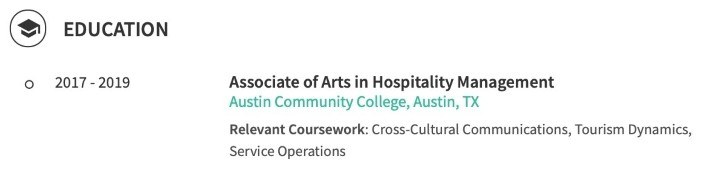
Most airlines in North America require a high school diploma or GED as a minimum. But having relevant post-secondary education can add a lot of strength to your application. That would be education in things like hospitality, tourism, communications, or health sciences.
Whatever your education, list the most recent and most relevant first.
Education Section Examples:
- Associate of Applied Science in Aviation Management, Embry-Riddle Aeronautical University, Daytona Beach, FL, 2022
- High School Diploma, Mainland High School, Daytona Beach, FL, 2020
- Bachelor of Science in Hospitality Management, University of Nevada Las Vegas, Las Vegas, NV, 2023
- Associate of Arts, College of Southern Nevada, Las Vegas, NV, 2021
- High School Diploma, Westlake High School, Austin, TX, 2019
Just a final note here. Be aware there are additional requirements that airlines usually verify before hiring. They can vary by carrier, so there might be some research you need to do. But they typically include:
- Valid passport
- Criminal background check, usually covering the past ten years
- Pre-employment medical checkup
- Proof that you are authorized to work in the country
Read more about how to structure education on a resume.
#5. Additional Sections
These sections can make you stand out in a sea of candidates who have similar qualifications, so make sure you use them if you can. Use them to show continued learning, professional development, and anything that airlines might value.
Courses
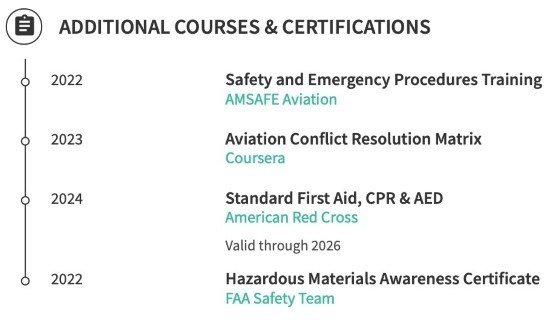
If you’ve completed any aviation or safety-related courses before being hired—this makes sense when you have no experience as a flight attendant—it signals your initiative and genuine interest. List course name, issuing organization and completion date.
Course Examples:
- Safety and Emergency Procedures Training, AMSAFE Aviation, Online, 2023
- Customer Service Excellence in Aviation, IATA Training, Online, 2025
- Conflict Resolution in Service Environments, Coursera, 2024
- Introduction to Cabin Crew Operations, George Brown College, Toronto, ON, 2025
Certifications
Certifications carry a lot of weight in aviation hiring, so if you hold any of the following, make sure they’re clearly listed with the issuing body and date.
Certification Examples:
- Standard First Aid and CPR/AED, American Red Cross, 2023
- Hazardous Materials Awareness Certificate, FAA Safety Team, 2023
- Food Handler Certification, ServSafe (National Restaurant Association), 2022
- Dangerous Goods Awareness Certificate, IATA, 2023
Language Skills
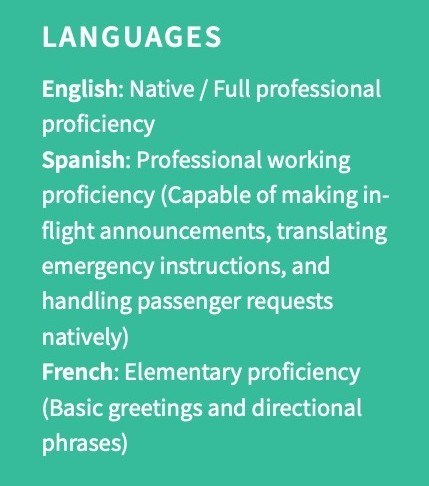
Bilingualism is a genuine advantage in aviation, and on international routes, it can be a deciding factor on who gets the job. List languages in a resume clearly with an honest assessment of your proficiency level.
Language Skills Examples:
- English: Native / Full professional proficiency
- French: Professional proficiency. Able to handle in-flight service requests, announcements, and passenger concerns.
- Spanish: Conversational. Comfortable greeting passengers and assisting with basic requests.
- Mandarin: Elementary. Basic greetings and directional phrases.
Tailor Your Resume for Every Application
There is no one-size-fits-all resume for every airline or every flight attendant position. Delta Airlines, for example, emphasizes premium service and crew professionalism. So a resume for Delta should highlight experience delivering exceptional, personalized service, as well as your composure in demanding situations. But Alaska Airlines is known for its warm and genuine crew culture, and they tend to value interpersonal skills and team-first attitudes.
What would happen if you failed to tailor your resume in this case? You probably wouldn’t even get an interview call if you highlighted the wrong things.
Read each job post carefully. Airlines will often include specific language about what they’re looking for—things like a safety first mindset, ability to work independently, and cross-cultural communication skills. Mirror that language in your resume if you’re honestly able to.
This is also important for applicant tracking systems (ATS). Airlines will use ATS to scan resumes before human eyes even see them, and if your resume doesn’t have the keywords it’s looking for, your resume is rejected. To get past ATS filters:
- Use standard section headings like Work Experience, Education, Skills, etc. Don’t get creative.
- Use keywords directly from the job posting.
- Avoid tables, text boxes, and graphics.
- Save and submit your resume as a PDF unless the application specifies something else.
Tailoring your resume is always worth it.
Final Thoughts
A flight attendant resume shouldn’t be just a list of jobs. It’s your first chance to make an impression of how you present yourself, communicate, and pay attention to detail. A clean, well-organized, typo-free resume shows the same professionalism they want to see in the cabin.
Start with a strong personal profile, back it up with specific experience and results, then round it out with skills, education, and certifications that show you're ready to hit the ground running. Then wait for that call.
Next Steps
Your resume is just one piece of the package that creates your application.
Write A Targeted Cover Letter
- Don’t just repeat your resume. Use your cover letter to complete the picture.
- Research the airline’s values, mission statements, culture, and brand voice before you write a word.
- Mirror their tone—do they sound warm and fuzzy or all about getting the job done?
- Keep it to one page and close with a clear call to action.
Prepare For the Interview Process
- Find out what the hiring process is like. Do they have online screening, one-on-one interviews, or something else?
- Be ready to talk about anything on your resume, including every role you’ve ever had, your results, and the certifications you’ve listed.
- Practice questions like “Tell me about a time you handled a difficult passenger” or “Describe a time you had to make a quick decision when under pressure.”
- Prepare questions to ask in a interview to make a good impression.
- Research the airline’s safety culture, fleet, and routes so you can speak knowledgeably about them.
Get Your Paperwork in Order
Airlines often require the following documentation:
- Valid passport
- 10-year background check clearance
- Pre-employment medical assessment
- Work authorization documents to work in the country
FAQs
What should I put on my resume for a flight attendant?
Add any relevant additional sections like certifications, courses, and language skills. Focus on things like customer service, safety awareness, and teamwork, since these are all competencies airlines are looking for.
What are the skills of a flight attendant?
Flight attendants need a strong combination of technical and interpersonal skills. For technical, use skills such as first aid and CPR certification, knowledge of safety and emergency procedures, regulatory compliance, and cabin service operations. For soft skills, clear communication, empathy, cultural sensitivity, composure under pressure, and the ability to de-escalate conflict quickly and calmly. Of course, only use what you can honestly list.
What airline pays flight attendants the most?
Delta Airlines consistently ranks as one of the highest-paying carriers in North America. In 2025, including bonuses, senior cabin crew earned $115,000 or more.
What type of personality is best for a flight attendant?
Flight attendants must love being around people. They’re typically warm, adaptable, and extremely patient. And they have to stay that way when they’re trapped in a confined space with no escape from people who are stressed, tired, frustrated, angry, or just plain mean. A strong sense of humor would be a big help too.
Do flight attendants need to speak two languages?
No, it’s not a general rule, but it can be a huge advantage. In fact, for international routes, it will push you right to the top of the application pile.