Acting Resume: Example and How to Write One
Your acting resume needs to make your experience easy to understand at a glance. Casting teams should be able to find your credits, training, and relevant skills without working through job descriptions or a lengthy career introduction.
An acting resume is a one-page document that presents your performance credits, training, special skills, and contact information. Submitted alongside a current headshot, it helps casting teams understand your experience and suitability for a role. Its layout emphasizes productions and roles rather than conventional job descriptions.
Select the actor resume credits that matter for the opportunity in front of you. Below, you’ll find a full example, formatting guidance, five practical writing steps, and advice for getting started without professional credits.
How to Write an Acting Resume
The usual acting resume format is a readable, one-page layout with clear headings and three-column credits. Leave dates and long descriptions off your credits, and keep enough white space for someone to scan the page comfortably.
Maintain a master document containing all your credits, then select the strongest relevant entries for each application. A screen submission might lead with film and television; a stage audition might put theater first.
For an acting resume headshot, choose a current, professional photograph that reflects how you look now. Avoid heavy retouching, costumes, or an old image that no longer resembles you.
Submission instructions determine how to send them:
- Casting platforms: Complete the requested profile fields and upload your headshot, credits, and supporting files in the formats specified.
- Email submissions: Use a clearly named PDF, such as Jordan-Lee-Resume.pdf, when requested. Check that reel and website links work.
- In-person auditions: Bring an 8 × 10-inch headshot when requested, with your resume trimmed to fit and stapled securely to its back. Avoid loose paperclips.
US Letter paper measures 8.5 × 11 inches. Keep your print layout within an 8 × 10-inch area before trimming, rather than cutting through the text. Open Jar Institute’s headshot and resume guide illustrates the print pairing and recommends PDF for digital resumes.
Acting Resume Example
Download this actor resume sample in PDF
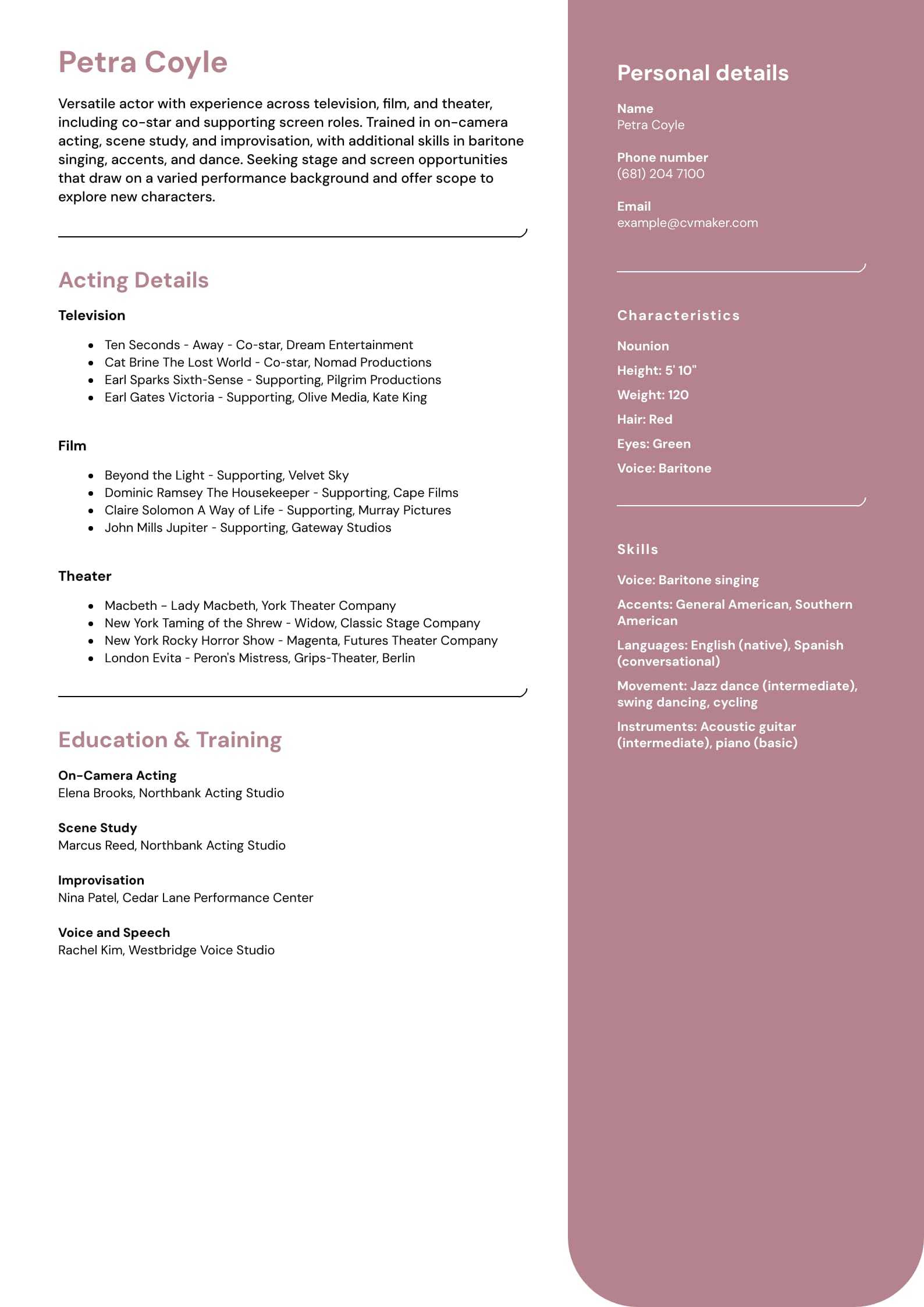
Petra Coyle’s acting resume shows how to organize film, television, and theater credits alongside relevant training and special skills. This fictional example keeps each credit concise, making the production, role, and director or company easy to identify.
Notice how the credits are grouped by medium and the skills occupy a short line. Those choices leave room for relevant training without adding a second page. Weight, which appears in the sample, is optional unless requested.
Choose an acting resume template through CVMaker’s resume builder and adapt the sections to your performance background. You can also browse our resume examples for layout ideas, while keeping the industry-specific structure explained here.
What to Include in an Acting Resume
Gather these essentials before formatting the page, adding optional details only when relevant:
- Professional name: Use the name that appears on your casting profiles and headshot.
- Union status: List your actual membership or confirmed eligibility, where applicable.
- Contact or representation: Include a professional email and phone number, or your representative’s agreed contact details.
- Physical details: Height, hair color, and eye color are commonly included; weight is optional unless requested.
- Credits: Name the production, your role, and the company, director, or venue.
- Training: Include relevant degrees, classes, conservatories, and coaches.
- Special skills: List abilities you can demonstrate at the stated level.
- Optional extras: Add a relevant award, reel, or professional website.
Leave out unrelated employment descriptions and sensitive personal information. The FAQ below explains what else to exclude and when child-actor details differ.
How to Write an Acting Resume in 5 Steps
- Create a clear header with your professional name, contact information, and accurate union status.
- Select specific acting and performance skills that match the casting notice.
- Organize relevant credits by medium in three easy-to-read columns.
- List your acting education and training with the school or teacher.
- Add useful extras, then check that everything fits on one page.
These steps help you gather the content; the finished page will usually place credits and training before special skills. All written examples below use fictional performers, productions, and training providers.
1. Acting resume header and summary
Make your professional name the most prominent text. Use a reliable email address and phone number, or follow your agent’s preferred contact arrangement. A city or working market can be useful, but your home address and Social Security number don’t belong here.
List union affiliations accurately beneath your name. These may include SAG-AFTRA, Actors’ Equity Association (AEA), or the American Guild of Variety Artists (AGVA), depending on your work. Eligibility is different from membership: use “SAG-AFTRA eligible” only when confirmed. Check SAG-AFTRA’s membership guidance rather than assuming that any production makes you eligible.
Height, hair color, and eye color can sit on one compact line. Unlike a conventional professional resume, a long summary paragraph is uncommon. If useful, add a brief type or specialty line, such as “Bilingual actor with physical comedy training.”
Header example
- Jordan Lee
- Nonunion | Los Angeles, CA
- [email protected] | (323) 555-0146
- Height: 5'8" | Hair: Brown | Eyes: Hazel
2. Include acting skills
Read the casting notice and describe your relevant skills precisely, even when your credits are limited. “Conversational Spanish” provides more useful information than “languages.”
Only list skills you can demonstrate at the level claimed. For activities involving risk, such as stage combat, distinguish training from professional stunt capability. Keep the finished section to one or two concise lines when possible; don’t use rating bars or unexplained stars.
Best skills to add to your acting resume
When choosing special skills for acting resume submissions, consider these categories:
- Accents and dialects: Specify those you can sustain through a scene.
- Languages: State fluency or conversational ability honestly.
- Singing: Include your voice type and range when known.
- Dance: Name styles and proficiency, such as intermediate tap.
- Combat and martial arts: Identify techniques, training, or current qualifications.
- Sports: Include useful abilities such as swimming, skating, or horseback riding.
- Instruments: Name the instrument and your playing level.
- Driving: Mention a valid license or motorcycle endorsement when relevant, without document numbers.
- Improvisation: Specify relevant training or performance experience
- Example: Spanish (fluent); piano (intermediate); tap (intermediate); long-form improv; licensed driver, manual transmission.
Our resume skills guide can help you identify relevant strengths, but prioritize demonstrable performance abilities here.
3. Shine a spotlight on your acting credits
Organize your credits under headings such as Film, Television, Theater, and New Media. Put the medium most relevant to the audition first, then prioritize your strongest suitable work. Credits don’t need to run in chronological order.
Use three columns: production, role, and company or director. For a theater resume, the middle column normally gives the character’s name. Screen credits usually describe the role category. Use the designation that accurately reflects your booking, such as Lead or Supporting for film, and Guest Star, Co-Star, or Recurring for television.
“Principal” is the correct spelling when that designation applies. “Featured” does not automatically mean a principal or speaking role, so avoid using it to inflate background experience.
Film
Production - Role - Company or director
- Last Bus Home (short) - Lead - North Window Films / Maya Chen
- The Quiet Room (short) - Supporting - Harborlight Pictures / Evan Cole
Theater
Production - Role - Company or director
- Twelfth Night - Viola - Cedar Stage Company
- Our Town - Emily Webb - Lakeside Community Players
In Google Docs or Word, insert a three-column table and add one production per row. Adjust the widths so titles and company names remain readable, then hide the borders for a clean resume layout. If using a builder, check that its editor preserves the columns before exporting; don’t assume a pasted table will retain its formatting.
For commercial work, a line such as “Commercials: list available upon request” is often more appropriate than listing brands. This avoids implying that an old campaign necessarily creates a current conflict. Backstage’s commercial-credit guidance explains this distinction; a separate commercial resume is not universally required.
4. Acting education and training
Include relevant degrees, conservatory programs, ongoing classes, and substantial workshops. Name the subject and the teacher or school so casting teams can understand what you studied.
Beginners can give training more space, while experienced performers can select their most relevant entries. Dates are usually unnecessary in a compact performance resume; label current classes “ongoing” when helpful. Follow any application that specifically requests dates or a fuller education history.
Example of how to list training
These fictional entries show a simple format you can adapt:
Training category - Teacher or school - Location
- Scene Study (ongoing) - Mara Ellis / Cedar Acting Studio - Los Angeles, CA
- Meisner Technique - Northbank Conservatory - Chicago, IL
- Voice and Speech - Daniel Brooks - New York, NY
List genuine instruction, not an audition or a brief introduction to a casting professional presented as extensive training. For help selecting relevant learning, see our guide to courses on a resume.
5. Create an ensemble with additional sections
Use remaining space for information that supports your performance experience. A relevant acting award or nomination can help, but identify the recipient accurately. A film’s festival selection is not the same as an individual acting award.
For digital submissions, add a working demo-reel or professional website link. Keep labels clear and check access without requiring the recipient to sign in. If your representative requests an agency logo, use their approved version and placement, usually in the header. Leave optional extras out when they crowd the credits or push the resume onto a second page.
How to Write an Acting Resume with No Experience
Start with what you have genuinely done. If you have no professional credits, lead with training and include school productions, community theater, student films, or showcases. Label the context accurately; unpaid performance experience can still show the roles you have played.
If you have no performance credits at all, omit the empty credits section. An honest beginner acting resume can contain contact information, training, and relevant skills.
Beginner example
Avery Brooks
Nonunion | Chicago, IL
[email protected] | (312) 555-0182
Height: 5'6" | Hair: Black | Eyes: Brown
Training: Introduction to Acting, Northbank Studio; Improvisation, Cedar Youth Arts.
School theater: Our Town | Stage Manager | Brookfield High School.
Special skills: Alto singing; piano (intermediate); Spanish (conversational).
Here, “Stage Manager” is the character in Our Town, not a backstage job. Where a credit might be misunderstood, make its meaning clear.
Build experience through student films, community productions, improv groups, and carefully labeled self-produced scenes. Background work can help you understand a set, but generally keep it off a resume targeting speaking roles. If a background-casting application requests that experience, list it accurately in the relevant profile or separate record.
For children and teens, use a parent, guardian, or agent’s contact details. Follow legitimate casting instructions for age information and avoid publishing a child’s home address or personal phone number.
Key Takeaways
A clear submission makes your relevant experience easy to find. Before sending it, check the essentials:
- Keep the resume to one readable page.
- Group credits by medium and use three consistent columns.
- Pair it with a current headshot in the requested format.
- Tailor credit order and skills to the audition.
- List only genuine roles, training, and demonstrable abilities.
- Check digital links and prepare an 8 × 10-inch print version when needed.
Use CVMaker’s resume builder to organize your acting resume template, then review the exported document against the casting instructions before submitting.
FAQs
How do you list roles on an acting resume?
Group credits by medium, then use three columns for the production, role, and company or director. For theater, give the character’s name; for screen work, use the accurate role category. Prioritize strong, relevant credits instead of treating the page as a dated employment history.
How do you list commercials?
A common approach is “Commercials: list available upon request” or a note that commercial conflicts are available on request. Keep campaign details ready for your representative or casting team. This wording does not excuse withholding actual conflicts, and you should not imply credits you haven’t earned.
How do you make a resume for acting auditions?
Select credits, training, and skills relevant to the casting notice, and check that your contact details are current. Submit the file type requested by the casting team. For an in-person audition requiring printed materials, bring the resume attached securely to the back of your current headshot.
What should never go on an acting resume?
Exclude your Social Security number, home address, invented credits, exaggerated skills, and unrelated job descriptions. Don’t present background work as a speaking role or an entire production’s award as your personal achievement. Remove outdated or less relevant entries when stronger credits need the space.
What should a beginner’s acting resume look like?
A beginner’s page should be short, organized, and honest. An acting resume with no experience can emphasize training and demonstrable skills; add student, school, or community productions when available. Leave out empty sections and resist padding the document with unrelated employment or fictional performance credits.
Should an acting resume include dates?
Dates are usually omitted from performance credits, which are organized by medium and relevance. Training can also be listed without attendance dates. An award year or “ongoing” class label may provide useful context. Supply dates separately if a casting platform, school, or application specifically asks for them.
Should I include my age?
Adults generally leave their exact age and birth date off the resume. A playing-age range describes roles you can plausibly portray, not your actual age. For minors, provide accurate age information through the requested casting process, with a parent, guardian, or representative managing the submission.
What size should an acting resume be?
Keep it to one page. For printed materials attached to a standard headshot, use an 8 × 10-inch resume or trim US Letter paper to fit. For digital submissions, follow the requested dimensions and file type; check that nothing is cut off in the exported PDF.
Do I need a separate resume for theater?
A dedicated theater resume helps when you have enough stage credits to select from. Put theater first and emphasize character roles, voice, movement, or dance where relevant. With fewer credits, one combined page can work well, provided the stage experience is easy to locate.