

How to Write a Basic, Simple Resume? Tips to Create a Simple Resume Fast and Easily!
Are you a recent graduate looking for your first job? Perhaps you are on the hunt for greener pastures. If you are in either of the above situations, you need an impressive resume to put you ahead of the other applicants. Writing a resume is not a walk in the park; those two pages will determine whether you will get an interview. Therefore, there is a lot of pressure to stand out from other applications. The good news is you do not have to work on your resume alone. Here is a guide with details on what to include in your resume, what to leave off, and what employers expect.
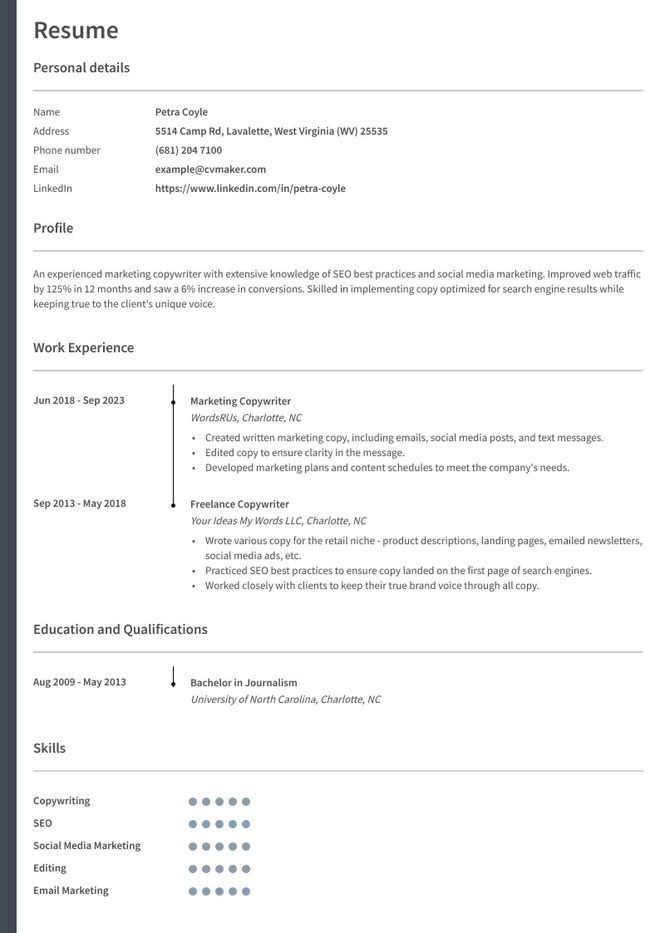
Simple Resume Example
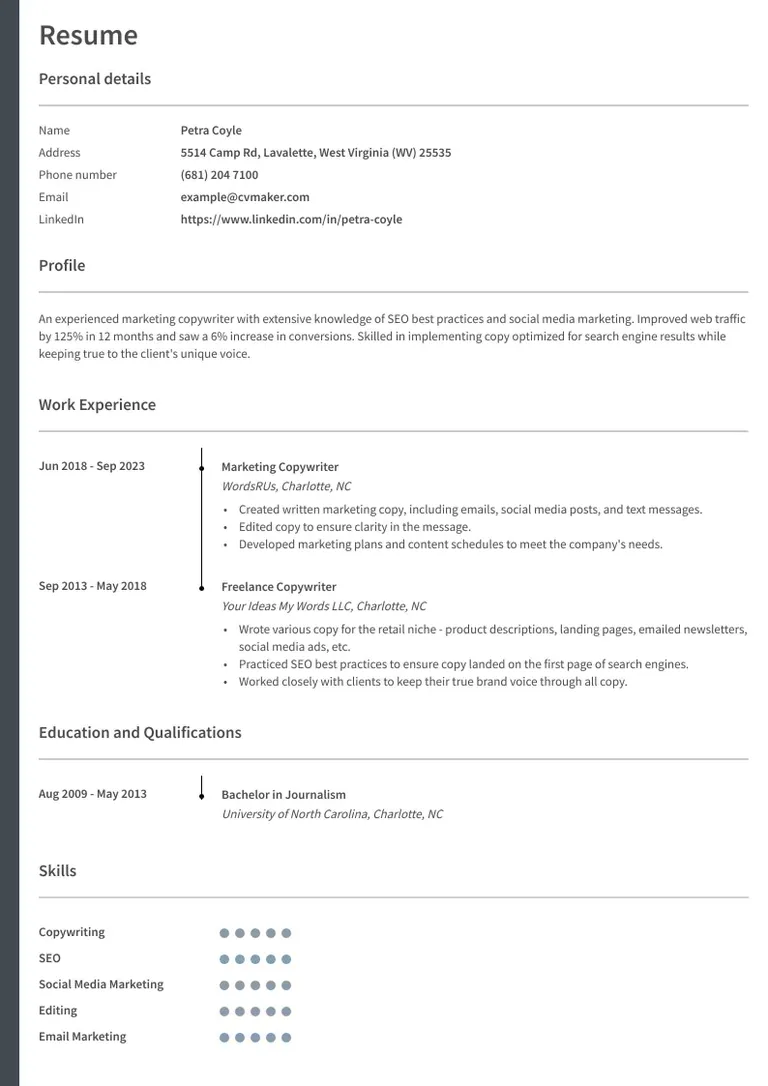
Download this simple resume sample in PDF

What Are the Must-Have Sections in Your Resume?
Your resume must contain the following sections to provide adequate information to the recruiter:
1. Personal Details
While contact information is a no-brainer, you would be surprised to know that a few people forget to include some of their details. You should provide your full name, professional title, personal email address, and mobile phone number. Other optional information you can provide is your LinkedIn profile and a professional website. However, you should not mention the following:
Work email address and any current business contacts.
Irrelevant social media URLs.
Photographs
You should also make sure your email address is professional, not some fancy or funny email. While you should provide a phone number, your voicemail message needs to sound professional.
2. Personal Statement
The personal profile is a critical part of the resume, and due to its noticeable position, the recruiter will see it first. Your objective when writing a summary is to provide a snappy overview of yourself. What key attributes do you have? What value can you add to the organisation? It is a short paragraph of two to three sentences, but the words should convince the hiring manager that your resume is worth reading. Here is what you should write:

Who you are.
Your achievements.
Two or three skills.
Your vision and what you intend to do for the new company.
Use action words to make it punchy and powerful.
However, you should refrain from writing a lengthy paragraph explaining why you want the job. Do not mention any irrelevant information.
3. Work Experience
Your relevant employment history is the centrepiece of the resume, and you should list your previous jobs in reverse-chronological order. Outline this section in the order below:
Official job title: Each entry should begin with an official job title in bold letters. The professional work titles highlight your career progress.
Company and location: Provide the name of the organisation address and city where you worked.
Duration of employment: Include the period you worked in the organisation by stating the month and year when you began and the date you left.
Duties and responsibilities: Provide a summary of your responsibilities and duties for each job position. However, they should be relevant to the post you are seeking.
Achievements: The accomplishments highlight how well you did your job. Here you can provide a list of statistics and figures that show evidence of your accomplishments. Use this part to convince the employers that you can add value to their organisation.
You should only provide information for 15 years of work experience. If you have worked more than 15 years, leave out short-term employment and internships. If you have minimum work experience, you can include internships and volunteer jobs.
4. Educational Background
The information to include in this section depends on your work experience. For instance, if you have more than two years of experience, only include post-secondary degrees by mentioning the graduation date, name of the institution, and your degree. If you are a fresh graduate, mention your honours, dissertation title, coursework that is relevant to the job, best achievements, and extracurricular academic activities. Dates are suitable for entry-level applicants, but if you have over ten years of experience, you can leave off dates.
5. Skills
You should include a minimum of five skills that are relevant to the position you are seeking. The technical skills are the job-specific hard skills like web development, IT skills, and statistical modelling. Your soft skills include effective communication, problem-solving, decision making, and critical thinking. You should indicate your language proficiency level and maybe illustrate briefly how you used those abilities in the past. However, it is crucial to remain relevant. Therefore, you should match the qualifications in the advert with the skills you have and include relevant keywords.
What Sections Can Be Left out on a Simple Resume?
The following sections are not mandatory, but you can include them to solidify your resume and get an interview:
Volunteer work: It provides a great experience to add to your resume and also shows your passions and interests outside your career.
Languages: If you have multiple language abilities, mention them as long as they are relevant to the employment you are seeking. However, your level of proficiency should be intermediate and above.
Awards and honors: Add relevant awards you have received in your profession, and you will easily land an interview.
Hobbies and Interests: You can mention your passions and pastime activities. However, do not lie or give generic hobbies, like watching movies or listening to music.
Conferences: If you have any significant events and conferences you attended in the past that are related to your industry, you should highlight them.
What Should You Leave off Your Resume?
Do waste time and space in your resume providing the following:
References: During application, you want to get your foot in the door, which means references do not serve any purpose. However, the recruiter may ask you to include references. Therefore, you can ignore the section, or add a clause indicating that you are willing to provide references upon requests.
Charts and Graphs: Some people use fancy tables to show their competency levels for skills or languages. However, they do not add any value. Therefore, instead of graphs, you can give figures and relevant statistics.
Photographs: Images do not add value to your resume unless you are applying for a modelling position. Therefore, refrain from including any photos and focus on mentioning your skills.
Lies: Honesty will help you avoid awkward and embarrassing situations during the hiring process. Do not provide any false information in your resume. If the recruiter is diligent, they could fact-check your information. Also, you should not hide the gaps in your resume. Any career breaks should be well-explained. You can provide skills gained during the time away.
What Does a Good and Basic Resume Look Like?
If you are using the reverse-chronological format, the order will depend on your work experience. A standard resume follows the following order:
1. Personal details
2. Personal statement
3. Employment history
4. Education
5. Skills
6. Extra sections
If you are a fresh graduate, your educational background comes after the personal statement. You can also use a skills-based resume to highlight the attributes that make you a perfect fit for the job.
How to Cope With Little or No Experience
Finding a job with little experience is an uphill battle, but that should not stop you. Here are a few ideas to help you get interviews:
Maximise Your Statement
Use the resume summary to illustrate why you are the ideal candidate for the job. Talk about your skills and show off your personality. Do not tell stories but provide concise information.
Highlight Your Skills
Even if you have no work experience, the transferable skills you get from college and volunteer programs are highly valuable. Some of the attributes you acquire are applicable in various fields, and the hiring manager may consider you for the position.
Pick keywords carefully
If the recruiter is using screening software, you need to use relevant keywords to ensure you pass the screening. Relevant keywords will give your resume a chance to reach the recruiter.
Creating a concise resume is necessary to land an interview and a job. With the above guide, you will have an easy time making your resume impressive.