


Whether you’re making an all-new resume or simply updating one that’s a bit old, you might wonder what sections are important to include. For instance, some individuals might benefit from adding interests on a resume, while others could be better off without it. Beyond the immediate question of whether to add those things, it’s also important to know which hobbies to put on a resume.
Hobbies and interests range from exciting outdoor activities to writing fun blogs or going fishing and catching up on documentaries about history. Our guide will share a few resume interest examples and give you details into what kind of things to add and other items to avoid as you craft a professional document.
Before we jump into anything else, we want to define exactly what hobbies and interests are. Hobbies are fun activities that you can do in your free time. Often, these are activities that help with tension and stress. Interests are subjects or fields you are curious about, such as technology, education, or environmental conservation. Unlike hobbies, they don't necessarily involve activities you regularly participate in.
As we move forward, think about what your own interests and hobbies are. We'll show you how to include relevant hobbies and interests, choose examples that match the job, and present them in a way that catches a hiring manager's attention. First, we want to delve into the reason to list interests and hobbies on a resume.

Why Should You List Hobbies and Interests for Resume Applications?
Many people can benefit from adding their hobbies and interests to a resume. For potential employers, it can be a great way to set yourself apart, especially if you may not have as much experience as you wish. Although hobbies shouldn't replace relevant professional experience, they can demonstrate transferable skills that aren't immediately apparent from your employment history.
Recruiters may appreciate relevant interests, particularly when they demonstrate qualities such as leadership, creativity, teamwork, or initiative. Employees who have interesting and rich hobbies can make a work environment lighter and may even help with the productivity of the employees. The most useful interests for resume sections are those that provide evidence of skills or experience relevant to the position, rather than simply filling empty space.
There are many reasons you should consider adding personal hobbies to a resume, such as the following:
Interests and hobbies on a resume help make it stand out from other applicants and candidates.
Recruiters will see your hobbies and get to know your personality. It’s a great way to share who you are.
This is an excellent space to add transferable skills, which are used in multiple different job roles.
You can show that you are an all-arounder by adding extracurricular hobbies and interests. It shows you care about more than just work.
If you have community involvement listed, your interpersonal skills can shine.
Adding a list of hobbies and interests to a resume can create fun discussions when you interview.
Team sports, volunteering, and community activities can demonstrate teamwork, commitment, and organizational skills when supported by specific examples.
Adding in a few hobbies in a resume shows that you have a vibrant and interesting life outside of the office. While employers want to see that you have the right technical skills, the best employee has more going for them than that. An employer can look at your interests and hobbies to find out more about who you are in both your professional and personal life.
How to List Hobbies in Resume Sections: 5 Practical Tips
Having a selection of hobbies on a resume is a great idea, but there are some things to be aware of when doing so. The act of adding hobbies in a resume is only one part of the process. You also want to be certain that the hobbies you list are the right ones and formatted in the best way.
When presenting hobbies in resume sections, prioritize activities that demonstrate relevant abilities and keep descriptions short enough for recruiters to scan quickly.
Whether you’re into comic books or mountain climbing, you run a book club, or you are engaged in artistic activities, you need to follow best practices when inserting those tidbits into your resume. Below, we’ll share some of these things so you can take them to heart as you create your list of interests and hobbies.
Tip #1: Understand why You Enjoy Your Hobbies
Everyone has different reasons to enjoy hobbies. While nearly everyone lists volunteer experience or educational experience on their resume, the same isn’t true for hobbies. Listing yours makes you stand out and can lead to interesting discussions if you move forward toward an interview.
So think about the reason you like the hobbies that are important to you. For instance, one person might like photography because it gives them a reason to look at gorgeous landscapes. Another person might enjoy this hobby as a way to remember the places and people they spend time with.
When you have a good idea of why the hobby is enjoyable, it’s easier to share that with a hiring manager. You’ll be better prepared to have a conversation about any of the hobbies if they do come up.
Tip #2: Stay Truthful
Some hobbies relate to hard skills, and others might improve soft skills. Creative people can come up with all sorts of hobbies that fit a job description. However, you should always be truthful when you list interests you have outside of work. This isn’t an area where you want to tell a fib.
There’s no reason to lie and say you enjoy something you don’t. It’s also generally not a good idea to exaggerate your interest in something. Once you make it to the interview, you could end up in trouble if the topic comes up and you aren’t as well-versed as expected.
For instance, someone who likes to walk around the block twice a week might not be fully truthful if they note they’re passionate about hiking. If the hiring manager is an avid hiker, they might strike up a conversation about your favorite trails, which will leave you scrambling to answer.
Avoid situations like this and be truthful. Instead of saying you love hiking, note that you care about physical fitness and spend 30 minutes a day, three times a week, on cardio walking around the neighborhood.
Tip #3: Work in the Specifics
Everyone wants to see a team player come into a position. Sharing hobbies and community service can show that you’re a great option for the role. When you start to share the interests and hobbies you have, make sure you stand out. This is best done by being as specific as possible. This will also make a great impression on the manager.
As an example, instead of typing that you “love learning languages,” note which languages you learn and whether you like to speak in them, read in them, or something different. This kind of specificity can be used for all your interests to make them come alive.
Whenever possible, describe what you accomplished. For example, "Volunteer mentoring — helped five high school students improve their writing skills" communicates more value than simply listing "volunteering."
Tip #4: Avoid Problematic Hobbies
Unique hobbies can make your resume memorable, but each activity should contribute positively to your application and remain appropriate for the position. Part of that involves avoiding crossing any lines that might make you seem less like an ideal candidate for the position.
There are several “rules” that will help you be sure that your interests and hobbies are safe to include on your list. The following should be avoided whenever possible -

Activities that could raise legitimate concerns about safety, legality, or professional judgment
Hobbies or interests that might be misinterpreted, even if meant as some sort of joke
Interests that provide personal information about your religious or political views
Tip #5: Pay Attention to the Job Description
As you are deciding which hobbies and interests to include, think about the job that you want to get. You want to be sure every entry will be received well and show that you’re a great fit for the culture. Start by researching the company on social media and its website to get basic information.
If there’s information about company culture, focus on that. Look into things like team building outings and work retreats the company has had in the past. With this knowledge, you can get an idea of what values are appreciated by the company and the people who work there.
After you know more about the culture of the company, create an interests section that highlights relevant things. Otherwise, you’re free to share any of the hobbies that you like. However, as we’ll soon talk about, some may be better choices than others. It all comes down to the position you want and what sort of tasks you will be doing on a daily basis.
For example, if you're applying for a web development position, maintaining a personal website or building coding projects can demonstrate technical skills and genuine interest in the field. Include a link to your portfolio when it showcases work relevant to the job.
When to Include Hobbies for Resume for Freshers and Career Changers
Potential employers don’t expect you to list all types of hobbies, but they don’t mind if you do. As we mentioned earlier, some people will find it useful to add interests while others may not. The individuals who will have the best results are those who may have limited work experience. Including hobbies and interests gives information about who you are away from the job, which can provide clues about what you’d be like in the office.
In addition, if you want to prove that you are well-rounded, interests can be a great way to show that. If this is the case for you, consider which hobbies show off your skills, and make sure to include some for hard skills and others for soft skills.
To sum it up, adding this section is useful for a college student seeking an internship or a candidate looking for a first job. People who have blank space on their resumes can add their interest, as can those who never finished school.
Students and Entry-Level Candidates
Students and recent graduates can use extracurricular activities to demonstrate skills they haven't yet developed in a professional setting. For example, participating in a student club, volunteering with an organization such as the American Red Cross, or organizing campus events can highlight teamwork, communication, and leadership.
If you're preparing your first resume, our education resume writing guide explains how to highlight academic achievements, relevant coursework, and extracurricular activities.
Candidates Without Professional Management Experience
If you're applying for a management position without having held a formal managerial title, leadership experience from outside work can strengthen your application. Serving as a team captain, club president, or volunteer coordinator can demonstrate your ability to organize people, delegate responsibilities, and make decisions.
For example, "Soccer team captain — coordinated weekly training for 15 players and helped organize regional tournaments" is more convincing than simply listing "soccer."
Career Changers
Hobbies can also support a career change by demonstrating experience and motivation related to your new field. For example, a lawyer transitioning into travel writing could highlight a personal travel blog, published destination guides, or independent writing projects.
The key is to connect your activities with the skills required for the new position rather than relying entirely on unrelated professional experience.
When to Skip Hobbies and Interests on a Resume
Whether you have an artistic hobby like 3D printing or you love to indulge in stock trading, your resume isn’t always the place to share that. If you have substantial professional experience, relevant achievements, and qualifications, hobbies may add little value unless they directly support the position you're applying for.
It’s a good idea to craft the rest of your resume to see if there’s sufficient space to add another section related to your hobbies. If not, that’s okay. The hiring manager will prefer to see other things before hobbies. Meeting requirements in other ways is completely acceptable.
To break it all down, people who are senior professionals do not need to include this section. The same applies to those with several years of experience or anyone who has a multiple-page resume to hand to recruiters.
For example, an IT project manager with 5–10 years of relevant experience will usually benefit more from highlighting completed projects, measurable results, and technical expertise than from listing unrelated hobbies.
Similarly, common activities such as watching movies or socializing are unlikely to strengthen an application unless they have a meaningful connection to the position. Instead, dedicate that space to information that demonstrates your qualifications.
If you need help prioritizing your professional achievements, our guide on how to write work experience on a resume explains what employers typically look for.
Hobbies vs. Interests: What’s the Difference? Does it Matter for your Resume?
Many people aren’t entirely sure of the difference between hobbies and interests. Despite what you may think, the two terms do not describe the same thing. Hobbies are things that you do regularly, such as studying foreign languages or learning new recipes.
Interests are subjects you enjoy learning about or exploring, even if you don't regularly participate in related activities. For example, someone might be interested in environmental conservation, artificial intelligence, or international cultures.
A hobby generally involves an activity, such as volunteering at environmental events, developing software, or practicing a foreign language. Both hobbies and interests can be included on a resume when they demonstrate relevant skills or knowledge.
Where on Your Resume Should You Place Interests and Hobbies?
Whether you want to show your interpersonal skills through hobbies or additional skills through interests, you should know where to place this section. There are two main areas where you can include this section to get the best results from including it.
A Separate Hobbies Section
Whether you use CVMaker's resume builder or create a resume on your own, you can include a section for your hobbies and interests. Adding a separate section is an easy way to separate this information from your work experience, education, and skills.
After creating the section, use a bulleted list of two to four relevant hobbies or interests, adjusting the number according to the available space and the strength of your examples. This will often look similar to the skills section that you need in any modern resume. For those with less work experience, you can be more detailed in this section. Adding a short description is a great option.
Whenever possible, quantify your interests with times, percentages, or other numbers. Having a short description can make up for having less professional experience. It can still show that you are a high achiever away from the workplace.
A Bottom or Sidebar Section for Hobbies and Interests
You can make a small section at the bottom or sidebar of the resume to show off your interests and hobbies. Keep in mind that hobbies can be helpful to a hiring manager, but they tend to be less important than other information. As such, placing it to the side or bottom only makes sense.
When it comes to choosing between a side or bottom bar section, look at the other information in the resume. Is it going to be extra cluttered if it’s at the bottom? In that case, consider shortening the list or using a simple single-column layout rather than moving important information into a sidebar. If there is more space in the main body to fill, leave it at the bottom there. It’s all a matter of what works for your situation.
A straightforward section with a clear heading and simple bullet points is generally the safest choice for readability. For additional formatting advice, see our guide to creating an ATS-friendly resume.
What are some Good Interests to Put on a Resume: 3 Examples of Listing Professional Interests and Hobbies
In the three professional interest examples below, you’ll see the many ways you can share who you are and what you care about on any resume. Use the examples of hobbies and interests to tailor your resume to read well and provide good information to a potential employer.
Our interests on resume examples are all unique but similar since these sections tend to look much the same way. You can add additional information as needed to explain why the hobbies are appropriate for the role you’re interested in.
When choosing interests to put on a resume, focus on activities that support the skills employers need. For more inspiration on presenting your qualifications, explore our professional resume examples.
Example #1
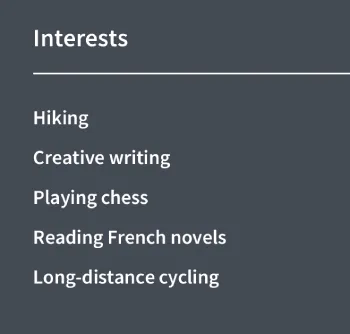
The first of our examples of professional interests has a range of hobbies, from hiking and long-distance cycling to playing chess, creative writing, and reading French novels. Each of the activities in the resume example says something about the potential workers and who they are, both in and away from the office.
For instance, physical activities show the person is interested in their health and wellness. Reading foreign novels and writing creatively show a sharp mind that is being honed to stay that way. Chess is another intellectual hobby that is a great choice for a resume.
Example #2
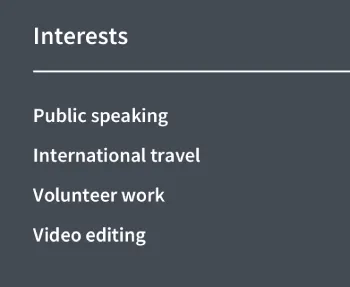
The next of our interest examples for a resume is a bit tighter. All of the hobbies included on the list can easily be compared to roles done at work. Some positions require travel, and that’s on the list. Others might require a lot of communication which public speaking has covered.
Other activities to put on a resume are also present, such as volunteer work and video editing. While these may not be the same hobbies you have, you can see how they all fit together for a specific job.
Example #3
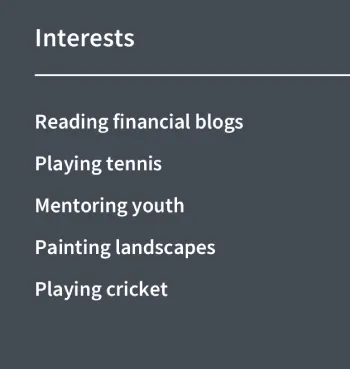
Our last example of interests on a resume has a blend of highly employment-related hobbies and personal interests. For instance, some of the hobbies include reading financial blogs and mentoring youth, both of which might be important for a certain position at a company.
On the other hand, playing tennis and cricket and painting landscapes might not relate to a job but still provide insight into what a person is like. With all of these things together, it gives exceptional insight into who someone is and whether they’d fit well in a certain job position.
Hobbies to Put on Resume Applications: Examples by Job
When choosing hobbies to put on resume applications, consider how each activity demonstrates abilities relevant to your target role. Here are some examples that show how personal activities can support different career goals:
Software developer: Building websites, contributing to open-source projects, or creating mobile applications can demonstrate programming skills and problem-solving.
Manager or team leader: Captaining a sports team or leading a community organization can highlight leadership, coordination, and decision-making.
Teacher or youth sports coach: Coaching a youth team, organizing school activities, or mentoring students can demonstrate communication, instruction, and organizational skills.
Writer or content creator: Maintaining a personal blog, publishing travel guides, or producing videos can demonstrate writing, research, and creative skills.
Community-focused roles: Organizing fundraisers or volunteering with nonprofit organizations can highlight teamwork, interpersonal skills, and initiative.
Whenever possible, include a specific achievement rather than simply naming the hobby.
What Interests to Put on Resume Applications?
When deciding which interests to put on resume applications, choose subjects that connect naturally to the position. For example, environmental conservation can be relevant to sustainability roles, financial markets to finance positions, and emerging technologies to IT-related jobs.
How to Choose Interests to Put on a Resume
The right interests to put on a resume should support your application without repeating information already covered in your skills or work experience sections. Focus on activities that offer additional evidence of your abilities or professional motivation.
How to Format Your Resume Interests Section
There aren’t a lot of things to keep in mind when it comes to formatting the resume interests section. Most of the time, the best option is a list, whether bulleted or not. This keeps things tidy and makes it easy to read all the information. We recommend this in most cases, but you can get more creative if you wish to.
The other option is to write a short paragraph about your hobbies and interests. However, this can be more challenging to read, so we don’t recommend it for most resumes. If it seems like a better choice, feel free to move forward with it.
For example, a concise resume interests section could look like this:
Hobbies and Interests
Volunteer mentoring: Support high school students with writing and career preparation.
Web development: Build personal websites using HTML, CSS, and JavaScript.
Community sports: Organize local soccer matches and coordinate team schedules.
You can keep the entries shorter if space is limited, but adding a brief description helps employers understand what each activity demonstrates.
Key Takeaways on Hobbies & Interests for a Resume
There’s a lot to think about when adding hobbies and interests to a resume. We’ll sum up the most important bits here, and you can get started with your own section. The first thing to remember is that you should only add interests and hobbies that make sense to be there and make sure you have the space for them.
As you come up with hobbies to list, research the company. Choose your interests and hobbies that fit into the culture of the company. Beyond that, select interests and hobbies that show your unique personality traits and transferable skills. Avoid illegal or controversial hobbies when making a list.
If you decide a hobby or interest section is a good idea, create a place for them at the bottom or side of your resume. Line them up separately and decide whether to expand on them with additional information. As a general guideline, two to four relevant examples are usually enough, although the ideal number depends on your experience and the position.
After you have that done, you’re good to go. Finish your resume, write a cover letter, and send in that application. You never know when a fun hobby will get you a seat at the interview table.
For more resume writing advice, interview preparation tips, and career guidance, explore the CVMaker blog.
FAQs
How Many Hobbies and Interests to List on a Resume?
It depends. Two to four relevant hobbies or interests are usually sufficient. Include more only when they provide meaningful information that strengthens your application. It provides information about you but doesn’t overtake other important factors.
Do Employers Care About Interests on Resumes?
Sure, many employers will pay attention to the interests in a potential employee’s resume. They can add weight and make the document more interesting. However, hobbies are not as much of a priority as skills, work experience, and education, so make sure those sections are also in great shape.
What do the Interests and Hobbies You Put on a Resume Tell Recruiters About You?
When a recruiter peruses your resume and sees a list of interests and hobbies, it’s likely to be seen as positive. It shows that you have some things that take up your free time away from work. Unless the hobbies are controversial or irrelevant, including them shows that you are a multi-faceted person.
What are Good Hobbies for Resume for Freshers?
For first-time job seekers, good hobbies include student club participation, volunteering, coding projects, blogging, team sports, and organizing school events. Choose activities that demonstrate teamwork, leadership, communication, creativity, or technical skills relevant to the position.
How to Describe an Area of Interest in Resume Applications
An area of interest in resume applications refers to a subject or professional field you're interested in exploring. For example, a marketing applicant might list content creation, consumer behavior, or digital analytics. Keep your choices relevant to the job and be prepared to discuss them during an interview.


