

Nursing Resume Examples & Tips for 2026
When writing your nursing resume, you must include all the correct information. Your resume is the very first introduction you make, so you need it to be strong.
Resume writing has changed quite a bit over the years. Whether you are sitting down to write your first resume or you need to create one after years in the workforce, you need to get the most up-to-date information about what to include and general guidelines for crafting a winning nursing resume.
Nursing Resume Example
Looking at RN resume examples can give you a better idea of what you need in your resume. These nursing resume samples also can assist you with figuring out how to word things in your resume if you struggle with how to explain specific details, such as your skills or job duties.
You can also use resume templates for nurses that give you a helpful guideline to follow as you create your own. Templates help to ensure you include everything you should because it acts like an outline. According to Nurse Journal, your goal should be to create an accurate and comprehensive resume that highlights your skills, nursing experience, and training. By following an example or template, you can ensure you don’t miss any of the essential details.
Download This Nursing Resume Example

You can also use a sample resume or template to figure out which format works best and which are the best nursing skills for a professional resume. When it comes to format, there are three general options:
Reverse chronological
Functional
Combination
Reverse chronological is where you highlight your employment and list each entry from the most current to the least current. This works well if you have an extensive background with a strong employment history that lacks gaps or frequent changes.
A functional resume emphasizes skills rather than employment history, but it can make clinical experience and employment timelines harder for hiring managers to evaluate. For most nurses, a reverse-chronological format is the clearest choice. New graduates can use it to highlight nursing education, clinical rotations, and relevant experience.
A combination resume gives you the ability to showcase the most important aspects of your skills, abilities, history, and education. It strikes a good balance between the other two types of resumes. If you choose this structure, though, you must be careful with the organization to avoid confusion.
How to Write a Nursing Resume for a Nurse Job
Hiring managers do not have time to search through your resume to find the information they need. You need to present a document that is clear and organized. With that in mind, resumes for registered nurses should be easy to scan for information and follow a logical order.
If you look at sample resumes for nurse occupations, you’ll see they usually include some specific sections. While you certainly can change the order and add other sections, it is essential to keep everything in the document relevant to the job for which you want to apply.
Nurse resumes need to focus on highlighting the skills, experience, training, education, and other details related to the nursing profession. Leave out any extra information that does not clearly relate. Now, let’s get into the basics of what information you should include.
How to Prepare a Master Nursing Resume
Before applying for nursing positions, create a master resume that records your complete employment history, nursing education, licenses, certifications, clinical training, and professional achievements.
Include the names of healthcare facilities, employment dates, responsibilities, specialized procedures, and relevant accomplishments. Keep copies of your qualifications and other supporting documents in a secure folder.
When you find a position that interests you, review the job description and select the most relevant details from your master resume. Tailor your professional summary, skills, and experience to the employer's requirements without changing your actual qualifications.
Update your master resume whenever you complete additional training, earn a certification, or gain new clinical experience. For additional formatting inspiration, explore our resume examples.
Nursing Resume Heading and Contact Information
The heading of your resume gives your personal information. It should be very easy for the hiring manager to see who you are and how to contact you. Make sure you always review this section to ensure it is completely accurate, up-to-date, and lacks typos or other errors.
Start with your full professional name, using a name consistent with your application and licensing records where necessary. Add your nursing credentials after your name, such as BSN, RN, or MSN, if you've earned them.
If you go by a different name, include that as well. For example, some people go by their middle name; you can include that and explain at the interview the name you use.
After your name, you will list your credentials. Because education, training, and licensure are so important in nursing, it’s important to make it clear that you have the credentials necessary right from the very start.
Include your city and state, phone number, and professional email address. A full street address is usually unnecessary. You can also add an updated LinkedIn profile if it supports your application.
Now comes the contact information. The first listing should be your phone number. Make sure to include your area code. If you have multiple phones, make sure to indicate which number it is. For example, if you have a home phone and cell phone, just include which phone it is after the number in parentheses.
Next, you want to list your email address. It is important to ensure this is a professional email. You can use free services. The easiest option is to use a variation of your name as the address.
These details are all that you must have, but if you have a professional presence online, you can include that information. For example, if you have a LinkedIn profile or nursing blog, don’t hesitate to include them. Of course, this is really up to you, and it’s a good idea to use discretion when it comes to social media.
How to Format This Section
Clarity is essential for this section. It sets the tone for the entire resume. Make sure you use a large, clear font for your name. It should be the largest font on the page. Also, center this section. It helps it to stand out.
How to Write a Nursing Resume Professional Summary
There are several ways you can jump into the actual resume portion of the document. In the past, many people used an objective statement, which was simply a sentence or two explaining what you were looking for in a job.
Nurse Professional Summary
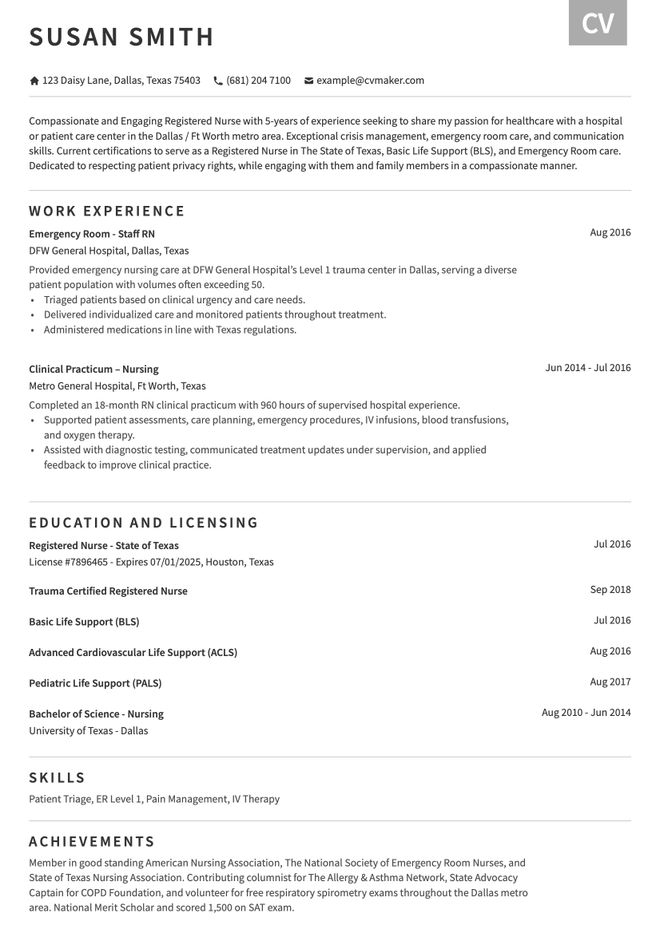
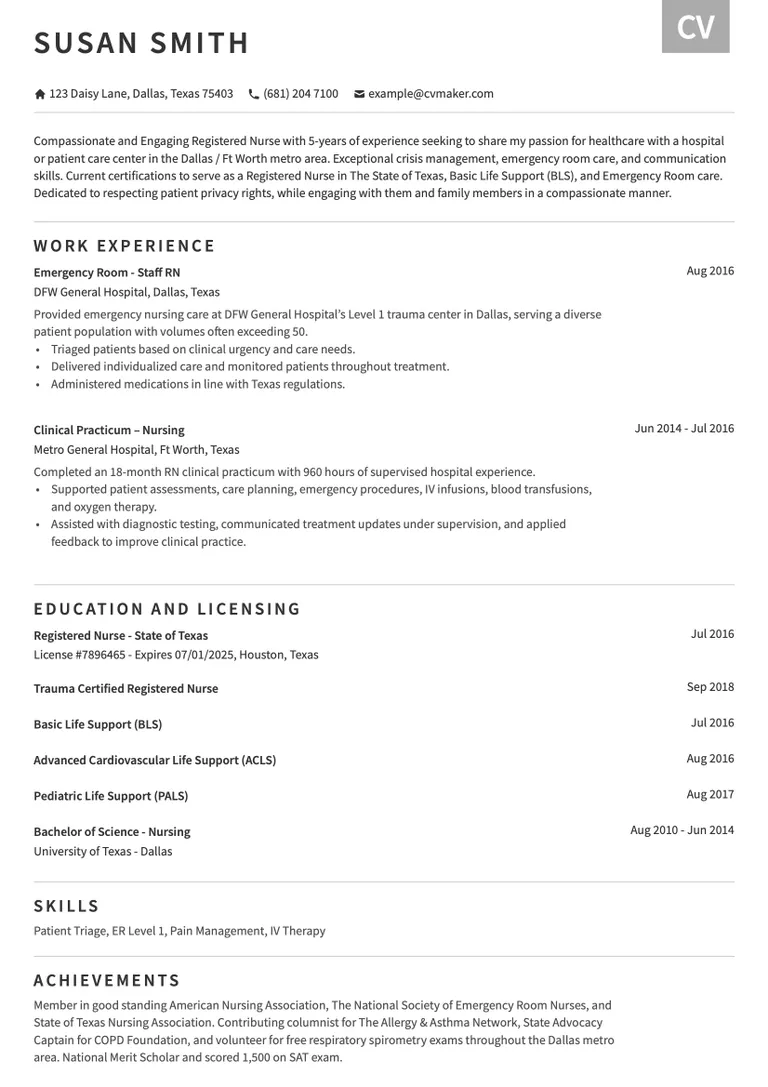
Compassionate and Engaging Registered Nurse with 5-years of experience seeking to share my passion for healthcare with a hospital or patient care center in the Dallas / Ft Worth metro area. Exceptional crisis management, emergency room care, and communication skills. Current certifications to serve as a Registered Nurse in The State of Texas, Basic Life Support (BLS), and Emergency Room care. Dedicated to respecting patient privacy rights, while engaging with them and family members in a compassionate manner.
However, the trend now is to use a professional resume summary, which gives some highlights about who you are and what you have to offer. This is preferable since it offers useful information to the reader and allows you to state upfront why the person should hire you.
Consider this section as your resume introduction. It is going to provide the reader with an overview of what is to come. You want it to grab attention and entice the hiring manager to keep reading. Showcase the most relevant details about yourself in this section. You can cover how long you’ve been working as a nurse, where you have worked of note, special certifications you hold, or any leadership experience you have had.
Whatever you include should match what the employer is asking for in the job description. You should also aim to include some of the same keywords.
Nursing Resume Summary Examples
The following examples illustrate how to tailor your professional summary for different nursing positions.
Experienced Registered Nurse
Compassionate registered nurse with 7 years of experience in acute care, patient assessment, and interdisciplinary care coordination. Skilled in managing complex patient needs, supporting treatment plans, and providing education to patients and families.
New Graduate Nurse
Recent Bachelor of Science in Nursing graduate with clinical training in medical-surgical nursing, pediatrics, and community health. Experienced in patient assessments, vital signs monitoring, and patient education during supervised clinical rotations. Seeking an entry-level RN position focused on safe, patient-centered care.
Emergency Department Nurse
Registered nurse with 5+ years of emergency department experience, including patient triage, rapid assessment, and coordination with multidisciplinary teams. Skilled in responding to changing patient conditions, communicating under pressure, and delivering compassionate care in fast-paced settings.
Use these examples as a starting point, but adjust your qualifications, clinical experience, and skills to match the position. A nursing resume summary should emphasize what you can contribute to the employer rather than provide a lengthy explanation of why you entered the profession.
How to Format This Section
The top rule about the professional summary is to keep it brief. You need to stay on point and be exact in your wording. You can write it as a paragraph, using no more than two or three sentences, or you can make a bullet list of a few items.
Nursing Resume Skills: Clinical and Soft Skills
The next important section will cover your skills. You should use a mix of hard and soft skills relevant to the profession. The University of Northwestern–St. Paul explains you should use skill phrases that will offer enough information on the ability.
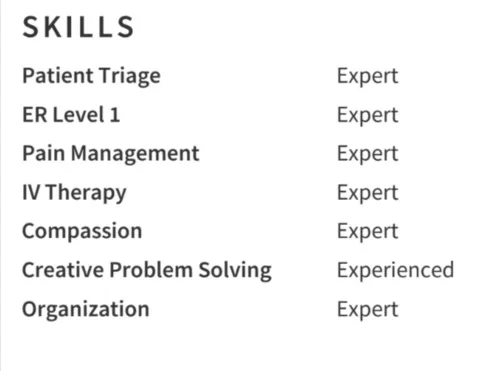
The reason why you want to use skill phrases instead of just a generic list is that this will tell the hiring manager that you have the necessary abilities and know how to use them.
Clinical Skills to Include on a Nursing Resume
Depending on your qualifications, specialty, and scope of practice, relevant clinical skills may include:
| Hard skills | Soft skills |
|---|---|
| Patient assessment and vital signs monitoring | Compassion and empathy |
| Medication administration | Communication |
| IV therapy | Critical thinking |
| Infection prevention and control | Decision-making |
| Wound care | Teamwork |
| Pain assessment and management | Time management |
| Specimen collection | Adaptability |
| Urinary catheter care | Working under pressure |
| Enteral feeding and nutrition support | Attention to detail |
| Nursing care planning | Emotional intelligence |
| Patient and family education | |
| Electronic health records (EHR) documentation | |
| Basic Life Support (BLS) |
Only include clinical procedures and certifications you're qualified to perform or currently hold.
To craft a skill phrase, you want to begin with an action verb. Then, explain what you did, how you did it, and the result. This gives a complete picture of the skill that shows practical application at the same time. If you're a new graduate, highlight clinical skills developed during supervised rotations alongside transferable skills such as communication, teamwork, and time management. There are many transferable ones that you can list and that could apply to the profession. Be sure to include some of the keywords from the job description here. Ideally, your list will match up with the desired skills list in the job description.
How to Format This Section
The skills section of your resume should be a bullet list. If you have a lot of skills you want to include, you can write them out in columns. Try to keep the writing tight and brief in this section. Get to the point and do not make each skill point too long. You want this to be skimable.
How to Write Nursing Resume Work Experience
The work experience section is your chance to talk about what you have done professionally in the past. For many hiring managers in the nursing profession, this is the section they will focus on because they want to find details that show you are honest about what you say in the rest of the resume.
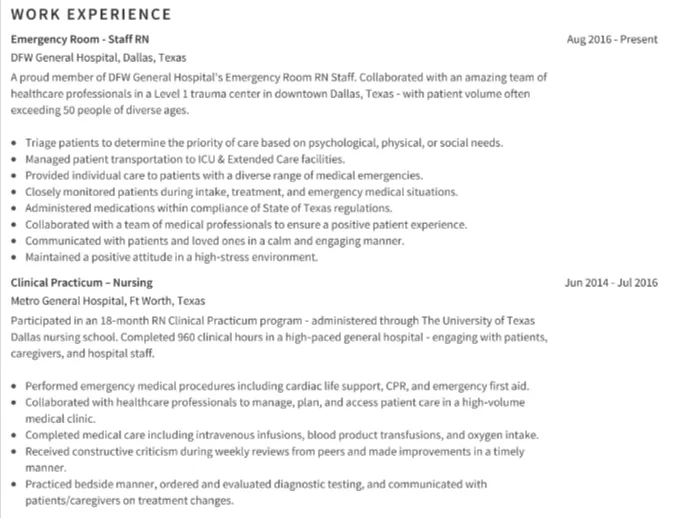
Be honest about your responsibilities and clinical experience. Use specific examples to demonstrate your skills, and never claim to have performed procedures or held positions that weren't part of your experience.
With that in mind, you need to make this section incredibly specific and detailed. For each entry in this section, you must list your job title, the name of the facility, and the dates of your employment. Then, you will give some insight into what your job entailed.
Explain what your normal duties typically entailed. Talk about any special tasks you undertook, with a particular focus on the most important you had. Avoid talking about basic nursing tasks as the hiring manager will assume you performed those responsibilities anyway. They will instead likely be looking for what made you stand out at your previous jobs.
The best details will showcase how you made improvements, overcame challenges, or went above and beyond.
Nursing Resume Work Experience Examples
Your work experience should show not only where you worked, but also the type of care you provided, the patients you supported, and the responsibilities you managed.
Examples of effective nursing experience bullet points include:
Provided individualized care for up to five medical-surgical patients per shift, conducting assessments, administering medications, and updating care plans.
Supported patients with acute and chronic conditions through ongoing monitoring, symptom management, and patient education.
Mentored three newly hired nurses during orientation, reinforcing documentation procedures and patient safety protocols.
Collaborated with physicians, therapists, and other nursing staff to coordinate discharge planning and follow-up care.
Educated patients and caregivers on medication schedules, wound care, and post-discharge instructions.
These examples are illustrative. Use your actual responsibilities, patient volumes, and achievements. Never include patient-identifying information or confidential medical details.
If you don't have paid nursing experience, include relevant clinical placements, internships, or volunteer experience, clearly identifying supervised responsibilities. For more tips, read our guide on how to write work experience on a resume.
How to Format This Section
Generally, you will only include the past ten years worth of jobs. If you have only worked in two or three jobs your whole nursing career, then you can list all of them. However, make sure anything you include speaks to your current abilities and adds something good to the resume.
List the entries in reverse chronological order. Start with the job title, followed by the facility name and the dates of employment. You can usually just list the month and year for the dates—no need to get specific.
Present your job duties in a bullet list. Keep each as short as possible.
How to List Nursing Education on a Resume for Nurse Job Applications
Education is pretty important in nursing. You must have the proper education to work in this profession. It is not legal to work as a nurse if you lack the right training, so hiring managers want to verify your background.
The education section is a basic list without bullets. You will include the name of the institution and degree. You can list dates if you’d prefer, but it is not a requirement. In addition, you could list your GPA if you want, but it is not something you have to include.
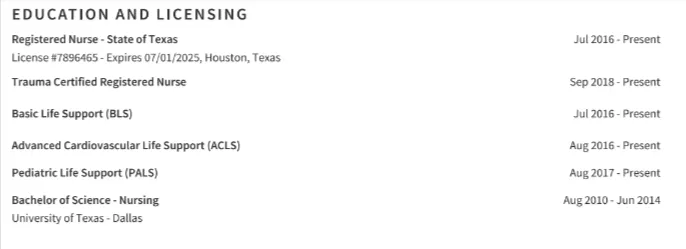
You can include anything of note. For example, if you graduated with honors, then you can include that in the entry. If you are currently attending school, you should note that on the entry. This way, the hiring manager understands you are pursuing the degree but do not yet have it.
Once you've earned a qualifying nursing degree or diploma, high school information is generally unnecessary. Instead, prioritize your nursing qualifications, relevant clinical training, honors, and continuing education.
How to Format This Section
For each entry, you should list the degree title first. Follow that with the institution's name and any other details you wish to include, such as honors. Organize your list with the most recent degree first.
How to List Nursing Licenses and Certifications on a Resume
To work as a nurse, you must have a state license. The hiring manager will check into this. It is helpful to include the information right in your resume.
If you hold other important certifications, such as an advanced nursing certification, you can include that in this section as well.
Include your nursing license type, issuing state or jurisdiction, and current status. Mention multistate licensure privileges when applicable. You generally don't need to publish your license number on a resume unless the employer requests it.
If you have certifications of relevance to the job for which you are applying, make sure to include those as well. Be detailed, so it is clear what certification you hold. Do not assume the hiring manager will be familiar with it.
List relevant certifications such as Basic Life Support (BLS), Advanced Cardiovascular Life Support (ACLS), or Pediatric Advanced Life Support (PALS) only if you currently hold them. Include the issuing organization and expiration dates when relevant.
How to Format This Section
Spell out credentials when clarification is helpful, but familiar abbreviations such as RN, BSN, BLS, and ACLS are appropriate in a nursing resume. Use clear, consistent formatting throughout the section.
For example, you might list "Registered Nurse (RN), Illinois — Active" followed by your current certifications, their issuing organizations, and relevant expiration dates.
Nursing Resume Accomplishments and Professional Development
The accomplishments section may include a variety of achievements that help to showcase your skills and abilities. However, you should only include nursing-related accomplishments unless there is something truly outstanding and rare, such as a Nobel Prize, that you would naturally want to include.

The accomplishments section may include items such as special awards you won from a particular employer, professional memberships, community awards, and even volunteer work. Essentially, this is the section in which you can brag about what you have done that is extraordinary.
Professional development can also help demonstrate your commitment to nursing. Relevant achievements may include completing specialty training, participating in quality improvement projects, mentoring new colleagues, or contributing to patient education initiatives.
For example:
Completed specialty training in wound care and assisted with updating patient education materials to support consistent discharge instructions.
Include only accomplishments that accurately reflect your contributions.
How to Format This Section
For awards, you should format it starting with the name, organization, and year. For memberships, you can list the organization name and the dates active. Format volunteer work with the job title or just put volunteer, the organization, and the dates. You can also list the location if it is of importance.
A Word About References
You may wonder where the section for references is. It used to be a requirement to include references in your resume, but that is no longer a rule. Now, employers will only ask for references if they want them.
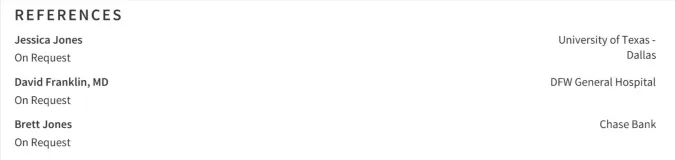
You should never include them or any remark, such as “references upon request,” on your resume. Not only will the hiring manager probably never read this section, but it also takes up space where you can put more valuable information.
Final Points on Writing a Nursing Resume
The biggest takeaway from how to write a nursing resume is that you want to keep things as simple for the hiring manager as possible. Only include relevant information, and keep everything as brief yet detailed as possible. If the hiring manager can easily read the document, it will greatly help you towards securing the interview. One of the best ways to do this is to look at registered nurse sample resumes.
Before submitting your resume for nurse job applications, proofread it for spelling, grammar, and inconsistent dates. Check that your credentials and certifications are current, and ask someone you trust to review the document.
For more guidance on formatting your application, see our article on creating an ATS-friendly resume and explore other CVMaker articles.
FAQs
While you’ve learned a lot about nursing resume writing, you may still have some lingering questions. Here is a look at three of the most common queries people have.
How long should a nursing resume be?
A nursing resume is typically one or two pages, depending on your experience. New graduates can often use one page, while experienced nurses may need two. Advanced practice, academic, or research roles may require additional space for relevant qualifications and accomplishments.
Don't shrink the font or margins excessively to meet an arbitrary page limit. Prioritize readable formatting and relevant information.
Should nursing resumes be one page?
The old school of thought was to keep resumes to just one page. However, the most important thing is to include all the important information, and if you can’t do that on one page, then you can make your resume longer.
The most important thing to keep in mind is to use a structured resume format that outlines your years of experience (where applicable) in the healthcare industry as a nurse.
How do I make my nursing resume stand out?
The best way to ensure your resume ends up in front of the hiring manager is to understand Applicant Tracking Software (ATS). ATS is becoming more prevalent as a way to sort resumes before a human looks at them. It helps to save time and remove resumes that do not meet the requirements.
The applicant tracking system is a sorting system. It will look for whatever someone programmed it to look for. While you will have no idea what this criterion is, there are some things you can do to give you the best odds of moving past the ATS.
Applicant tracking systems vary in how they process and screen applications. Not every system automatically rejects a resume that lacks a particular keyword. Use relevant job-description terms accurately, spell out qualifications when helpful, and maintain a clean, readable structure.
The first thing is to use standard headings. Do not try to get fancy or creative with the section headings. Instead, stick with a tried-and-true approach as it is probably what the ATS program itself features.
Include terminology from the job description when it accurately reflects your qualifications. For example, if the position requires experience with electronic health records, mention the EHR systems you've actually used. Avoid keyword stuffing or adding credentials and procedures you don't possess.
Make sure your resume has a clear structure. Keep formatting simple as well. If it is too complicated, the ATS may overlook the content because it cannot figure out how to read it.
By formatting for an ATS, you also will ensure a clear and crisp resume, which is a bonus even if the employer does not use an ATS to filter resumes.
How do I write a nursing resume with no experience?
If you're applying for your first nursing position, focus on your education, clinical rotations, relevant certifications, and transferable skills. Describe the patient care responsibilities you completed under supervision and highlight specialties such as medical-surgical nursing, pediatrics, or community health when relevant.
A nursing resume sample for a new graduate can help you organize this information without making your experience appear more extensive than it is.