

What do you think is one of the first sections a hiring manager looks at when receiving a resume? If you said work experience, you are right on target. Having a well-written work experience section will make job seekers' resumes stand out. If your work history shows the skills listed in the job description, the hiring manager has a reason to keep reading.
Based on this, when it comes to moving forward in your career path, the work experience on a resume template should focus on the experience most relevant to the role. Hiring managers often review resumes quickly, so clear job titles, dates, and concise bullet points help them identify relevant experience. Use the steps and examples below to describe your work experience clearly, accurately, and concisely.
Why is the work experience section of a resume important?
There are tons of reasons to include relevant experience on a resume. The first is that many employers consider it the most important section. Its importance depends on the role and your level of experience. The work experience section is often read first, which makes it essential for moving forward in the process of obtaining new employment.
When prospective employers look at the job experience in a resume, they use it to decide whether you have the skills and experience to succeed in whatever role you have applied for. In addition, you’ll go into detail about your accomplishments, which is a great way to stand out from other applicants and get your foot in the door.

What to – and not to – include in your resume work experience section
When it comes to the work history in a resume, there are many things to include but just as many to avoid inserting. Information about the job you are applying for and what your employment history looks like will determine what to add.
If your work experience is scattered, don’t worry. It’s becoming more and more common (and accepted) as time goes on. Adding side projects and part-time gigs is useful if any skills are related to the position you’re applying for now.
When it comes down to it, you need to be ready to answer questions about your work choices, be able to explain your career path, and be honest about how much commitment you’re interested in. After you decide which positions to list, there are several things you should add as you insert them into the resume. Each should have -
Action verbs – Action verbs are considered strong and work well in a resume format. Choose accurate verbs such as “designed,” “coordinated,” or “improved” instead of exaggerated claims.
Awards and honors – If you receive recognition at your job for great work, that’s something you want to include. Explain what the recognition was for when it relates to the position.
On-site training – If you gained certifications and skills on the job, those are great things to include. It can be a good way to showcase skills and prove you take initiative at work.
Quantitative info – Numbers can make your impact easier to understand. They’re tangible and specific. Whether you managed 20 clients each week or grew a reader base by 150%, make sure you include those details.
Results-based facts – Show what changed because of your work, not just the tasks you were assigned.
Now that you know what to include on your resume, we want to delve into the things you should avoid. Some things do not need to be explained to the hiring manager. In addition, resumes have limited space, so you want to include only the most important bits.
You can do that by avoiding the things below -
Basic job requirements – Avoid repeating duties that are obvious from your title, but include responsibilities that demonstrate your scope and relevant skills.
Filler text – Remove filler phrases and first-person pronouns when possible, but keep your writing clear and grammatical.
Irrelevant information – Small responsibilities that have no bearing on the new position can be left out. Every word and bullet point should be focused on selling you.
What the company does – Avoid lengthy employer descriptions. A short phrase about an unfamiliar business can help clarify the context of your work.
How to write work experience on a resume in 5 steps
You want to know how to write a job description on a resume. Once you learn what to write in a resume for work experience and use it for a past entry, the others will be easier to compose.
Step 1: Add a clear work experience heading to your resume
The first step in creating a job history on a resume is making a heading that catches the eye. This can make you an appealing candidate from the very start. Use a familiar section name, such as “Work Experience,” so employers can find your employment history quickly.
One thing to take into consideration here is that the title looks better if it’s a bit larger than the actual description. Use bold if it matches the style of your other resume section headings.
Step 2: Place your resume work experience section strategically
Choose the section order based on which qualifications best match the job you are applying for. If you have relevant professional experience, place your work history near the top of your resume, usually after your summary. If you are a student or recent graduate, you can lead with education or relevant projects, followed by work experience.
For a detailed education-first layout, read our education resume example and writing guide.
Step 3: List work experience on your resume in reverse-chronological order
In most cases, employment history should be done in reverse-chronological order. First, put your current or most recent position at the top of the section. Then move down and add the next most recent. Follow that format as you continue.
If a recent part-time job is less relevant than an earlier internship, keep the dates accurate and give the internship more detail, or feature it under a separate “Relevant Experience” heading.
Step 4: Format every resume work experience entry consistently
For each role, give your job title, employer, city and state (or “Remote”), month-and-year dates, a short description of your role, and relevant achievement bullets. You’ll see several examples below to give you better insight into what this might look like for you.
It’s fine to start with the company name or your position, either order is acceptable. However, work toward consistency. If you do it one way on the first job, keep that up with all the rest.
The same applies to dates of employment. Make sure they’re in the same area with identical alignment.
Step 5: Write achievement-focused bullets for your work experience
Give more detail to the roles that are most recent and relevant to the job you want. Use fewer bullets for older or less relevant positions.
For every point, you want to focus on your achievements. Don’t stick to simple job responsibilities and duties. There’s no need to add every single task you ever did. Instead, add the ones that are relevant and that you can include quantifiable information about.
TIP:
As you write, use power words and action verbs so you create a persuasive message. You should also be sure that all your entries support the skills you say you have. Use keywords from the job description only when they accurately describe your work.
How to tailor work experience on a resume to a job description
Before writing your final job descriptions, make a rough list of your responsibilities, relevant skills, training, and measurable results. Then compare that list with the job posting.
Keep the responsibilities and achievements that match the employer’s needs; remove details that do not strengthen your application.
Order bullets within each role so the strongest matching results appear first.
Use the employer’s terminology only when it is accurate. For example, “Waiter (Restaurant Server)” can clarify an equivalent title, but do not invent a position you never held.
Check that any work experience mentioned in your resume summary is supported by specific evidence in your work history.
For more advice on clear formatting and relevant job-posting keywords, follow our ATS-friendly resume guide.
Resume work experience examples for engineering, pharmacy, and tutoring
Now that you know what an employer expects, we want to share a few resume experience examples. Using professional experience examples for a resume lets you get a visual idea of how your document should look. This is a great way to see if you are on the right track or not. Below are three existing image examples, each followed by an additional text-based example. Use the most relevant professional experience resume example as a guide for your resume.
For additional role-specific layouts, browse our professional resume examples.
Example #1: Electrical engineering resume work experience
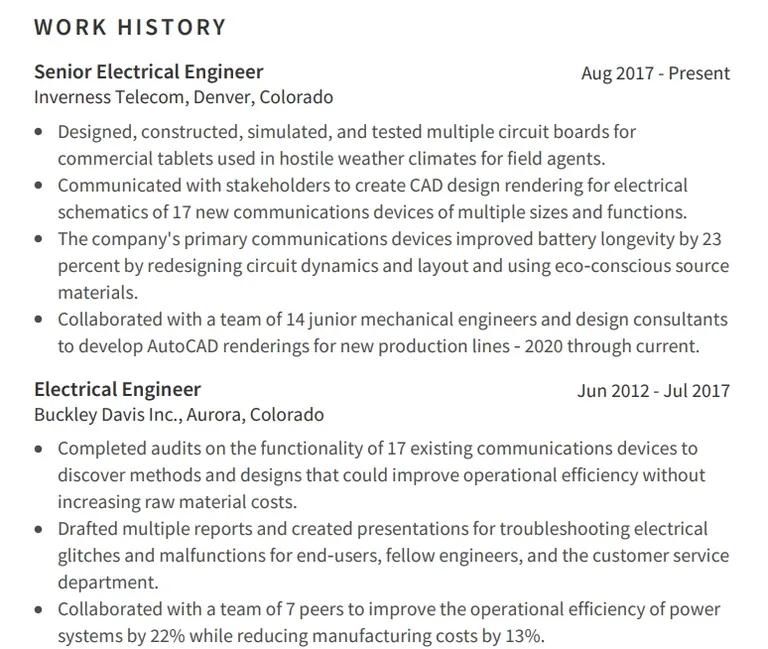
This first resume work experience example is for an applicant who is searching for a job in an electrical engineering position. You can see how her previous work experience is laid out and incorporates many of the tips we just provided to you.
Why this electrical engineering work experience example works
This work experience example contains two past jobs. Each of them has a well-made heading that includes all the needed information about the job role, company name and location, and dates of employment.
When you get into the bullets, you find action verbs and plenty of numbers to go with the achievement.
Example #2: Pharmacy resume work experience
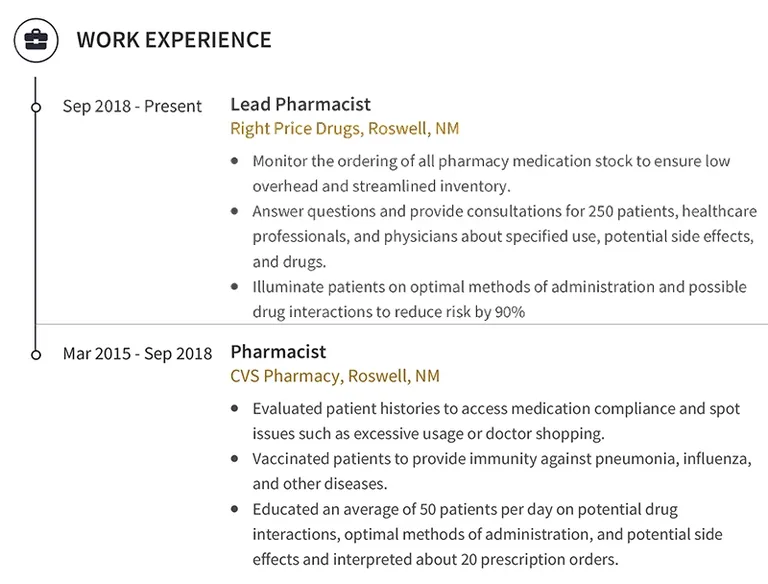
Next up, you get a glimpse at what a hiring manager might see when a potential pharmacist sends in their resume. It offers two work positions from the past, along with limited bullet points under each of them.
Why this pharmacy work experience example works
Previous employers will appreciate the way the work experience is laid out here. It’s simple to see where one job ends and the next begins. The person who created the work experience section made sure to quantify their achievements and use keywords from the job description to tie everything together.
Example #3: Tutoring resume work experience
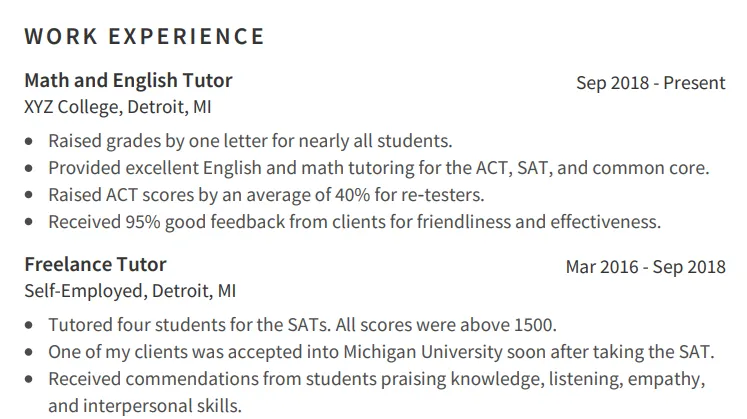
Finally, we have an example employment history for someone who wants to work as a tutor. You can see the last two jobs they had in various tutoring positions. Everything is laid out professionally with the appropriate information, including dates of employment.
Why this tutoring work experience example works
Future employers want to see your previous work experience and how well you did in past positions. This applicant makes that clear by describing how they helped students improve their grades and do well on various standardized tests. You can also get an idea of where their skills are the best.
How to format work experience on a resume
When you’re listing resume job experience, you want to be sure you show off your job responsibilities in the correct resume format. Each bit of relevant work experience should look the same, or it can be confusing to read. Being consistent shows you have an eye for detail and know how to follow the rules.
A few tips that will help you create the best work experience section include -
Format all entries the same with details like the company name and location, job title, dates of employment, and list of responsibilities.
Use one consistent font and section-heading style throughout the resume; bold job titles can make entries easier to scan.
Make sure all sections are aligned in the same way, such as having right-aligned dates throughout.
Use the same font and method for all the headers to make sure this section of the resume is a breeze to read.
How to describe work experience on a resume: key takeaways
Now that you know what potential employers want to see in the work experience on a resume, all you have to do is spend a few minutes creating it. Make use of our resume builder to get it done fast. When you use the tips and examples above, you’re sure to have a work experience section to be proud of.
Whether you have only a bit of experience or decades to add, the work experience section is one of the most important for your resume. Get it right, and you could be moving forward in the process.
For additional resume-writing advice, explore our resume blog.
FAQs
How many years of work experience should you put on your resume?
When it comes to how much work history is on a resume, it can vary. It depends on how you ask. A common guideline is to focus on the most relevant 10–15 years, while adding older roles when they support your application. If it takes a bit more to fill the page, that’s okay. The same applies if you need to use less for the section.
What to put on your resume if you don’t have any work experience
Even if you don’t have experience, you can create a great resume. Rather than focusing on the work experience section, put your effort into showing off relevant skills. Add in projects, hobbies and interests, and hard and soft skills to your resume. Achievements and certifications can also be added to show what you are capable of.
If you have not held a paid job, include relevant internships, school projects, volunteer experience, or job-related training. Describe the work you performed and what you learned or achieved without presenting unpaid activities as paid employment.
How to write work experience on a resume with employment gaps?
Keep employment dates accurate and consistent. If an employer asks about a gap, explain it briefly and honestly; caregiving, training, travel, or volunteer work may also show useful transferable skills.
How to list work experience for a career change?
There are several things you can do on a resume for a career change. Tie old experience to the skills needed in a new position. Focus on achievements using data and numbers. Tailor the descriptions for each job using relevant keywords to show you have the needed skills.
Should you include all work experience on your resume?
Full-time jobs, part-time jobs, volunteer experience, and internships can all be included in your work experience. However, that doesn’t mean every role needs to be added. Those who have lots of experience can focus on the most relevant positions to create a better document.
Should you put unrelated work experience on a resume?
In most cases, it’s better to stick with relevant work experience on a resume. However, it also depends on the type of job and how much other experience you have. If your past employment is limited, go ahead and add in other positions. But you want to try to tie the experience in, so highlight skills that apply to the new role.
For example, a part-time restaurant server role can support an application for restaurant manager if it demonstrates customer service, cash handling, or shift coordination.
Can you lie about work experience on your resume?
No. False job titles, dates, or accomplishments can undermine your credibility or cost you an offer. Focus on genuine achievements and transferable skills instead.
How do you put international work experience on a resume?
So you’ve had additional experience, but it was in another country? You can still add it to your work experience section when building your resume. Format it like other experiences, and be sure to include the location. International experience is a great way to stand out!
How do you list remote work experience on a resume?
Having consistent employment experience for a resume is a good way to stand out. That includes both in-person and remote experience. If you want to showcase that you worked on a remote basis, simply add (remote) after the job title. However, you do not have to do this. It can look just like other positions if you prefer.
Is volunteer work experience on a resume?
Volunteer experience can be used as work experience on a resume. Just because you were doing good for free doesn’t mean it can’t be included. You’d insert it into a resume just like any other job you held. As long as the experience is relevant and shows off your skills, put it on the resume and let it shine.
How do you put stay-at-home mom on a resume without work experience?
Being a stay-at-home mom doesn’t need to be a detriment as you embark on your career journey. It can be used in the work experience on a resume, just like other jobs. List it with a title like “caregiver” or “home manager,” including dates, and put down some of the accomplishments you have.
How to write “currently working” in a resume?
If you’re still employed somewhere, you should list it on your resume with the rest of your work experience. All you need to do is list the basics (name of company, position, and location) as well as the date. Since you still work there, simply put “present” or “currently working” as the end date. Use “Present” as the end date for a position you still hold.