

How to Write a Flight Attendant Resume: Writing Guide, Tips, and Examples
So you’ve decided you’d rather work at 35,000 feet. That’s a great choice! A career as a flight attendant means travel, variety, and a schedule that’s about as far from nine-to-five as you can get. But before you can identify as part of the cabin crew, you need a flight attendant resume that will get you through the door to the plane.
The aviation industry is competitive, and airlines receive thousands of applications. Whether you’re fresh out of school or making a career change from hospitality, your resume needs to show recruiters—and ATS software—that you are who they’re looking for.
This guide will walk you through everything you need to craft a strong flight attendant resume, with realistic examples you can modify for your own application.
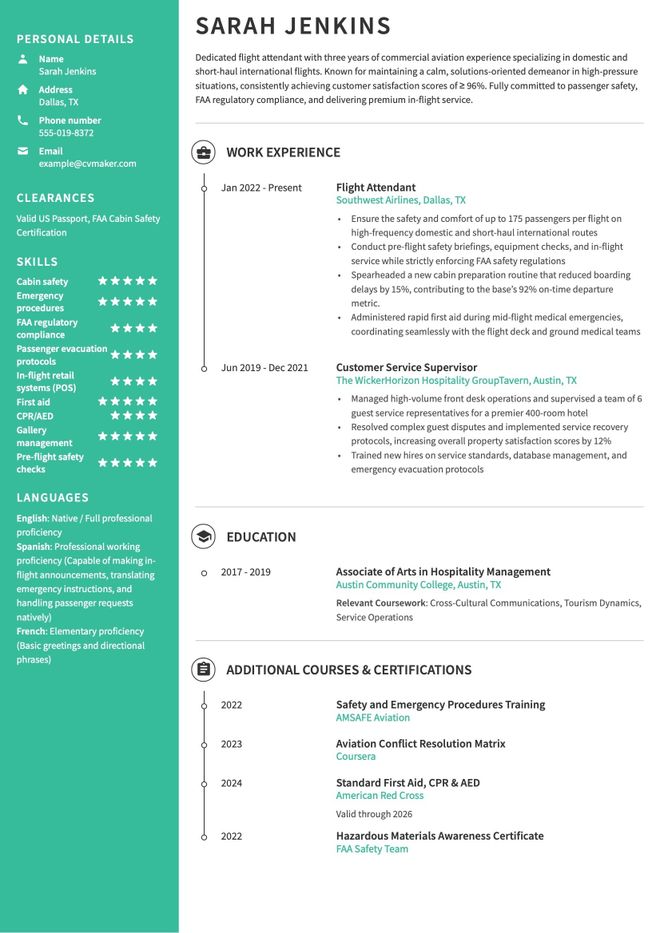
Flight Attendant Resume Sample
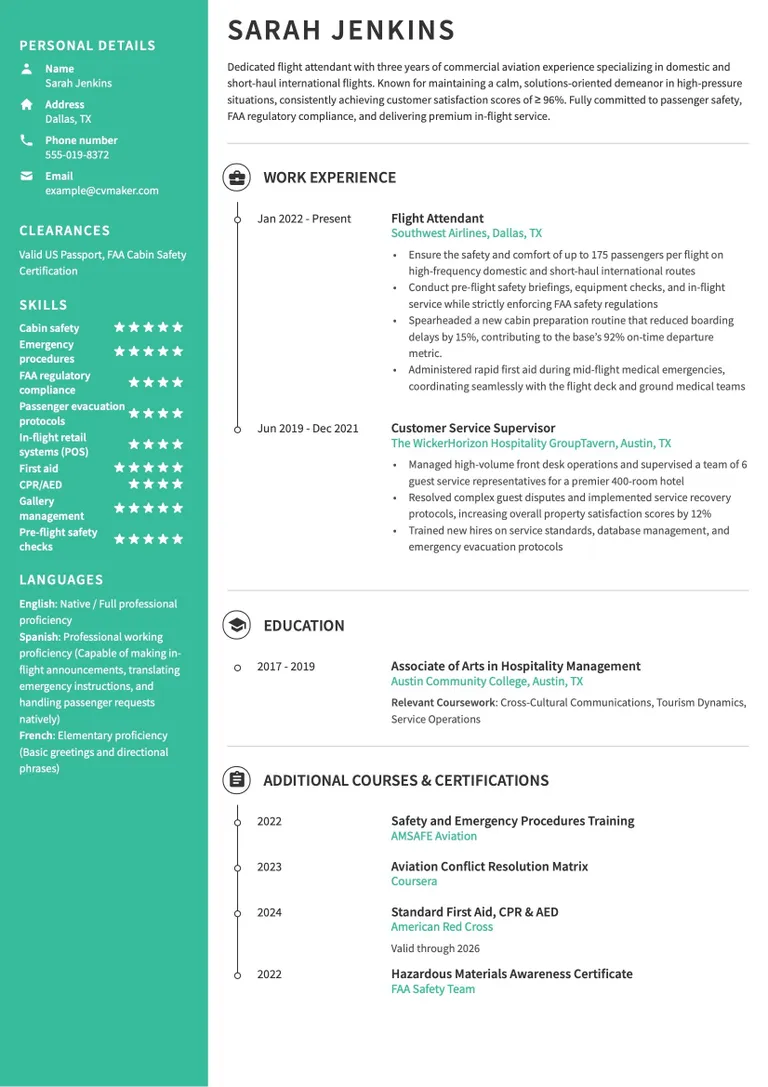
Download this sample flight attendant resume in PDF.

What to Include in a Flight Attendant Resume
Your resume should give hiring managers a clear, confident picture of who you are and why you’d be the perfect choice for the job. At minimum, they’ll expect to see the following:
Contact information: Your full name, cell phone number, professional email address, and city or region. Never provide a full street address.
Professional summary: A short introduction of about 3 to 4 sentences that highlights your experience, strengths, and what you would bring to the role.
Skills: A mix of hard skills and soft skills—technical and interpersonal.
Work experience: Relevant roles listed in reverse chronological order. Make sure you list accomplishments, not just duties.
Education: Your highest level of education, plus any relevant training or courses.
Additional sections: Certifications, courses, and language skills can set you apart, especially on some international routes.
Keep your resume to one page if you have less than ten years of experience. Two pages are okay for senior applicants with extensive history.
How to Write a Flight Attendant Resume in 5 Steps
#1. Personal Profile Section
Your resume personal profile—it’s also called a professional summary—sits at the top of your resume, right below your contact information. It’s the very first thing a recruiter reads, and in some cases, it may be the only thing they read if it doesn’t hook them right away.
Think of this section as an elevator pitch. You’re with someone for just a short time and only have a moment to pitch—or sell—an idea to them. You need to get them on board. With your resume, you have about four sentences max to communicate your experience level, strongest qualities, and your enthusiasm for the chance and role. Do not use generic phrases in this section. Never say things like you are a “hardworking team player.” You need to be specific about the kind of environments you’ve worked in, the results you’ve achieved, or any skills that would apply to cabin crew work.
Here are some flight attendant personal profile examples:
Entry-Level Example
Enthusiastic and customer-focused professional with two years of experience in high-volume restaurant service at a busy Miami waterfront venue. Known for staying calm under pressure, resolving guest concerns with a smile, and anticipating needs before they’re voiced. Passionate about travel and multicultural communication, and currently completing a First Aid and CPR certification through American Red Cross in preparation for a transition into aviation.
Experienced Flight Attendant Examples
Example 1
Dedicated flight attendant with six years of experience at United Airlines, specializing in passenger safety, in-flight service excellence, and emergency preparedness. Consistently recognized for achieving top customer satisfaction scores and maintaining composure in high-pressure situations. Fluent in English and Spanish, with a track record of connecting with travelers from all backgrounds. Now seeking a senior cabin crew role with expanded international routes.
Example 2
Bilingual flight attendant with five years of experience with Air Canada, delivering premium cabin service on domestic and transatlantic routes. Fluent in English and French, with strong cross-cultural communication skills developed across hundreds of international flights. Recognized for consistently high passenger satisfaction scores and a commitment to safety-first service. Seeking a new challenge with a carrier operating long-haul international flights.
Flight Attendant Supervisor Profile Example:
Results-driven Cabin Crew Supervisor with eight years of aviation experience, including three years leading in-flight service teams on transcontinental routes for Alaska Airlines. Skilled in staff coaching, safety compliance, and conflict resolution. Recognized for reducing passenger complaint rates by over 22% over two years through proactive team training and service standard improvements. Brings a calm, solutions-oriented leadership style to every flight.
#2. Skills Section
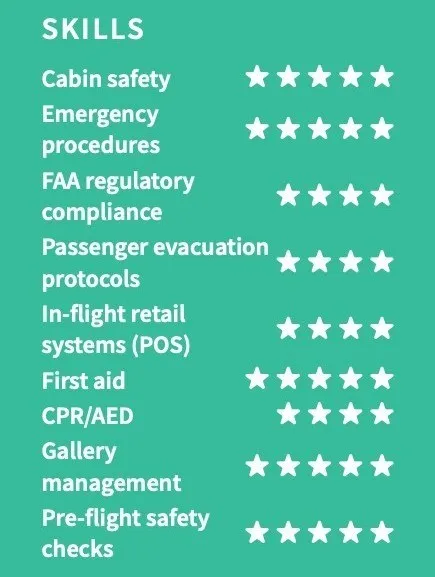
Recruiters spend seconds scanning resumes, and automatic tracking systems (ATS) take even less, so your skills section needs to be easy to read and immediately relevant. It should include a balanced mix of hard and soft skills. Hard skills are your technical, job-specific competencies, and soft skills are an indicator of how you work with people and handle pressure.
| Relevant Flight Attendant Hard Skills | Relevant Flight Attendant Soft Skills |
|---|---|
| First aid and CPR/AED certification | Conflict management |
| Cabin safety and emergency procedures | Problem-solving |
| FAA/Transport Canada regulatory compliance | Empathy and cultural sensitivity |
| Passenger evacuation protocols | Composure under pressure |
| Point-of-sale and in-flight retail systems | Clear verbal communication |
| Galley management and food service | Time management and adaptability |
| Language proficiency (beyond English) | Customer service orientation |
One last tip:
Don’t just list your skills in isolation—meaning add them to the skills section and forget about them. Wherever you can, show these skills in your work experience section with specific examples and results. Here’s an example:
Skills
Conflict management
Composure under pressure
Work Experience
De-escalated an in-flight dispute between passengers by calmly separating the parties, communicating clearly with the flight deck, and resolving the situation before landing. Received a commendation from the captain and a follow-up thank you from the affected passengers.
If possible, list your skill, and then prove your skill.
#3. Work Experience Section
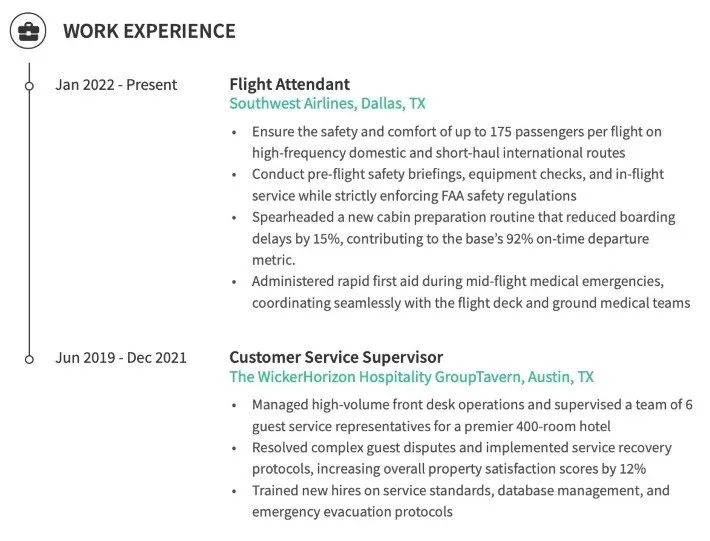
Your work experience section is the heart of your resume. List your roles in reverse chronological order, starting with your most recent position. For each role, include the job title, employer name, location, and dates of employment. Follow that up with a short paragraph that describes your responsibilities, then use bullet points to highlight your accomplishments.
Always use strong action verbs to open a bullet. And wherever you can, include numbers—percentages, ratings, volume of passengers, team size. That’s much more compelling than vague descriptions.
Strong action verbs include:
Managed
Coordinated
Implemented
Resolved
Trained
Achieved
Work experience examples - experienced candidates
Flight Attendant | Delta Air Lines | Atlanta, GA | 2019 – Present
Responsible for the safety and comfort of up to 190 passengers on domestic and international routes. Performed pre-flight safety checks, conducted safety demonstrations, delivered in-flight service, and responded to medical emergency situations in accordance with FFA regulations.
Maintained a 97% individual customer satisfaction rating across quarterly crew evaluations
Recognized three times with Delta’s Above and Beyond peer award for exceptional passenger care
Assisted in the onboarding and mentoring of eight new-hire flight attendants during initial reserve periods
Flight Attendant | Southwest Airlines | Dallas, TX | 2016 - 2019
Delivered friendly, efficient cabin service on high-frequency short-haul routes across the continental U.S., managing passenger boarding, safety compliance, and in-flight service in a fast-paced, no-frills environment.
Handled an average of four flight segments per day while maintaining consistent service quality and FAA compliance
Contributed to a team that achieved a 94% on-time customer satisfaction score across the Dallas Love Field base
Volunteered as a peer mentor during new-hire training weeks, supporting incoming flight attendants through their reserve transitions
What if you have no experience as a flight attendant?
Don’t worry, having no flight attendant experience doesn’t have to be a deal-breaker, especially for entry-level positions. In this case, airlines know you’re starting from scratch. But they will want to see evidence of your ability to handle people, pressure, and a fast-paced environment.
That means previous roles that transfer well, like:
Customer service
Hospitality
Retail
Caregiver
Food service
For skills, list abilities that overlap well like:
Communication
Conflict resolution
Multitasking
Handling stress well
Also, be specific about the environments you worked in. Were they high-volume, unpredictable, customer-facing, etc.
Work experience example - no aviation experience
Server | Capital Grille | Chicago, IL | 2021 - 2023
Delivered attentive, personalized service to guests in a high-volume, upscale dining environment. Managed multiple table sections during peak service periods, coordinated with kitchen staff, and resolved guest concerns promptly and professionally.
Handled an average of 60+ covers per shift while maintaining consistent customer service quality and accuracy
Received Employee of the Month recognition in March 2022 for outstanding guest feedback scores
Trained two new team members on service standards, table management, and POS systems
Explore more tips for writing a resume with no experience.
#4. Education Section
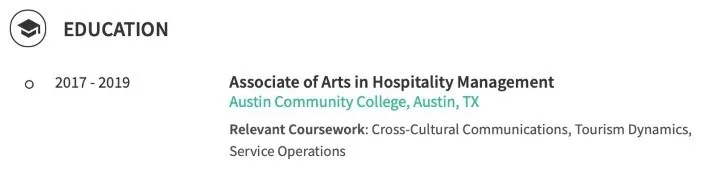
Most airlines in North America require a high school diploma or GED as a minimum. But having relevant post-secondary education can add a lot of strength to your application. That would be education in things like hospitality, tourism, communications, or health sciences.
Whatever your education, list the most recent and most relevant first.
Education Section Examples
Associate of Applied Science in Aviation Management, Embry-Riddle Aeronautical University, Daytona Beach, FL, 2022
High School Diploma, Mainland High School, Daytona Beach, FL, 2020
Bachelor of Science in Hospitality Management, University of Nevada Las Vegas, Las Vegas, NV, 2023
Associate of Arts, College of Southern Nevada, Las Vegas, NV, 2021
High School Diploma, Westlake High School, Austin, TX, 2019
Just a final note here. Be aware there are additional requirements that airlines usually verify before hiring. They can vary by carrier, so there might be some research you need to do. But they typically include:
Valid passport
Criminal background check, usually covering the past ten years
Pre-employment medical checkup
Proof that you are authorized to work in the country
Read more about how to structure education on a resume.
#5. Additional Sections
These sections can make you stand out in a sea of candidates who have similar qualifications, so make sure you use them if you can. Use them to show continued learning, professional development, and anything that airlines might value.
Courses
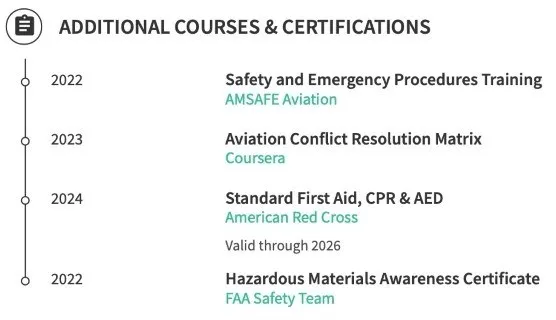
If you’ve completed any aviation or safety-related courses before being hired—this makes sense when you have no experience as a flight attendant—it signals your initiative and genuine interest. List course name, issuing organization and completion date.
Course Examples:
Safety and Emergency Procedures Training, AMSAFE Aviation, Online, 2023
Customer Service Excellence in Aviation, IATA Training, Online, 2025
Conflict Resolution in Service Environments, Coursera, 2024
Introduction to Cabin Crew Operations, George Brown College, Toronto, ON, 2025
Certifications
Certifications carry a lot of weight in aviation hiring, so if you hold any of the following, make sure they’re clearly listed with the issuing body and date.
Certification Examples:
Standard First Aid and CPR/AED, American Red Cross, 2023
Hazardous Materials Awareness Certificate, FAA Safety Team, 2023
Food Handler Certification, ServSafe (National Restaurant Association), 2022
Dangerous Goods Awareness Certificate, IATA, 2023
Language Skills
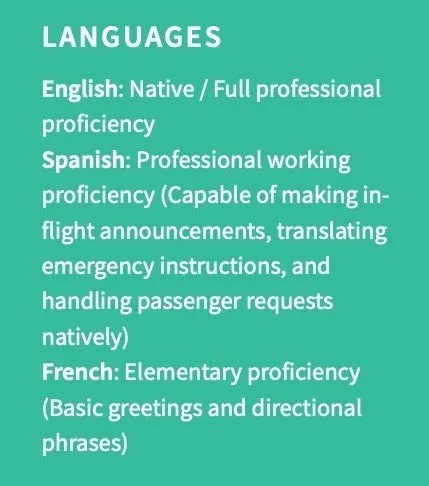
Bilingualism is a genuine advantage in aviation, and on international routes, it can be a deciding factor on who gets the job. List languages in a resume clearly with an honest assessment of your proficiency level.
Language Skills Examples:
English: Native / Full professional proficiency
French: Professional proficiency. Able to handle in-flight service requests, announcements, and passenger concerns.
Spanish: Conversational. Comfortable greeting passengers and assisting with basic requests.
Mandarin: Elementary. Basic greetings and directional phrases.
Tailor Your Resume for Every Application
There is no one-size-fits-all resume for every airline or every flight attendant position. Delta Airlines, for example, emphasizes premium service and crew professionalism. So a resume for Delta should highlight experience delivering exceptional, personalized service, as well as your composure in demanding situations. But Alaska Airlines is known for its warm and genuine crew culture, and they tend to value interpersonal skills and team-first attitudes.
What would happen if you failed to tailor your resume in this case? You probably wouldn’t even get an interview call if you highlighted the wrong things.
Read each job post carefully. Airlines will often include specific language about what they’re looking for—things like a safety first mindset, ability to work independently, and cross-cultural communication skills. Mirror that language in your resume if you’re honestly able to.
This is also important for applicant tracking systems (ATS). Airlines will use ATS to scan resumes before human eyes even see them, and if your resume doesn’t have the keywords it’s looking for, your resume is rejected. To get past ATS filters:
Use standard section headings like Work Experience, Education, Skills, etc. Don’t get creative.
Use keywords directly from the job posting.
Avoid tables, text boxes, and graphics.
Save and submit your resume as a PDF unless the application specifies something else.
Tailoring your resume is always worth it.
Final Thoughts
A flight attendant resume shouldn’t be just a list of jobs. It’s your first chance to make an impression of how you present yourself, communicate, and pay attention to detail. A clean, well-organized, typo-free resume shows the same professionalism they want to see in the cabin.
Start with a strong personal profile, back it up with specific experience and results, then round it out with skills, education, and certifications that show you're ready to hit the ground running. Then wait for that call.
Next Steps
Your resume is just one piece of the package that creates your application.
Write A Targeted Cover Letter
Don’t just repeat your resume. Use your cover letter to complete the picture.
Research the airline’s values, mission statements, culture, and brand voice before you write a word.
Mirror their tone—do they sound warm and fuzzy or all about getting the job done?
Keep it to one page and close with a clear call to action.
Prepare For the Interview Process
Find out what the hiring process is like. Do they have online screening, one-on-one interviews, or something else?
Be ready to talk about anything on your resume, including every role you’ve ever had, your results, and the certifications you’ve listed.
Practice questions like “Tell me about a time you handled a difficult passenger” or “Describe a time you had to make a quick decision when under pressure.”
Prepare questions to ask in a interview to make a good impression.
Research the airline’s safety culture, fleet, and routes so you can speak knowledgeably about them.
Get Your Paperwork in Order
Airlines often require the following documentation:
Valid passport
10-year background check clearance
Pre-employment medical assessment
Work authorization documents to work in the country
FAQs
What should I put on my resume for a flight attendant?
Add any relevant additional sections like certifications, courses, and language skills. Focus on things like customer service, safety awareness, and teamwork, since these are all competencies airlines are looking for.
What are the skills of a flight attendant?
Flight attendants need a strong combination of technical and interpersonal skills. For technical, use skills such as first aid and CPR certification, knowledge of safety and emergency procedures, regulatory compliance, and cabin service operations. For soft skills, clear communication, empathy, cultural sensitivity, composure under pressure, and the ability to de-escalate conflict quickly and calmly. Of course, only use what you can honestly list.
What airline pays flight attendants the most?
Delta Airlines consistently ranks as one of the highest-paying carriers in North America. In 2025, including bonuses, senior cabin crew earned $115,000 or more.
What type of personality is best for a flight attendant?
Flight attendants must love being around people. They’re typically warm, adaptable, and extremely patient. And they have to stay that way when they’re trapped in a confined space with no escape from people who are stressed, tired, frustrated, angry, or just plain mean. A strong sense of humor would be a big help too.
Do flight attendants need to speak two languages?
No, it’s not a general rule, but it can be a huge advantage. In fact, for international routes, it will push you right to the top of the application pile.