

Event Planner Resume Sample, Job Description & Writing Guide for 2026
Can you create a successful event while dealing with vendors, caterers, and venues? If you understand the event planning process from start to finish, you might be looking for a new position. Maybe it offers better pay and excellent benefits so you want to apply as soon as possible. You can do that, but make sure you have a great resume to start.
According to the U.S. Bureau of Labor Statistics, employment of meeting, convention, and event planners is projected to grow 6% from 2025 to 2035, faster than the average for all occupations. This includes work on business gatherings and personal events, from conferences to weddings.
If you want to get in on the best opportunities, it’s essential to have an amazing corporate event planner resume. You have to show a hiring manager that you have all the skills that make you a great employee for their brand. This needs to be a strong resume that focuses on your unique skills and strengths.
The good news is that this guide will help you craft that integral document. You can review a sample event planner resume for ideas, regardless of whether you are a seasoned veteran or someone just going into the industry. We’ll share a number of strategies and tips for writing a better resume. In addition, we’ll explain why your resume should be tailored to a specific job posting.

Event planner resume writing guide: Where to start?
Job seekers know that a resume is a must today. However, where do you start with making one that stands out? We believe that it is composed of two steps. When you follow our guide to creating a master resume and a job-specific resume, you’ll be closer to success. Make sure you have the event planner job description sample ready as you get started.
How to create a master event planner resume
Maybe you want to create a party planner resume where your experience is focused on special events. Perhaps you’re more focused on business conference events. It doesn’t matter what sector of event planning appeals to you. The first step in the process is to draw up a master resume that holds all your education, experience, skills, and other relevant details.
The master resume is separate from the resume that you turn in to the actual job posting. This document is for your benefit so you don’t have to worry as much about style, design, and aesthetic. You can put things in whatever order you want as long as you can decipher the information later when you need it for additional resumes.
All you need to do at this point is put down your information. Place your past employment, education, and skills on the master resume. Be as detailed as you can for the best results. Adding in accomplishments and tasks ensures you have that information available years down the road. There’s no need to do any guessing.
The information in the master resume doesn’t have to be relevant to one specific position. If it might be useful at any point in the future, add it and leave it there. You don’t want to delete something and end up needing it in the future. Once you start on the next phase of making a resume, you can use everything you added to fill out the details.
Update the master resume after each major event, new project, certification, or job so the details are ready when you need to tailor your next application.
How to tailor an event planner resume for a job posting
When you search for a sample event planning resume, that’s going to be similar to a job-specific event planner resume. This is the document that does get turned in to a hiring manager who decides whether to invite you for an interview. That means it needs to be tailored for the specific position. Sharing social events and large-scale events you’ve had a hand in is important.
The way you format the job-specific resume is just as important as what information you put on it. Reverse-chronological is recommended for most people, but there are other things to consider. A clear, single-column layout is often easier to read and may be more reliable for online applications. Have you thought about fonts and colors? All of these things come into play with a resume for a specific position.
It doesn’t matter what types of events you’re experienced with; you need to show that you can meet client expectations. Look at the job description or keywords and requirements that you can weave into your own resume. Use the space to make it clear that you’d be a great person in this specific position. Customization is how you do this for every job application you turn in.
For an event coordinator resume, highlight day-of schedules, vendor communication, staff assignments, guest services, and other hands-on responsibilities if they match the posting. If the job ad is brief, review the employer’s website and recent events to identify the type of work it does, then reflect your relevant experience accurately.
Keep the final document easy for employers to scan, and use this guide to an ATS-friendly resume when checking headings, layout, and job-related keywords.
Event planner resume sample
Download This Event Planner Resume Example
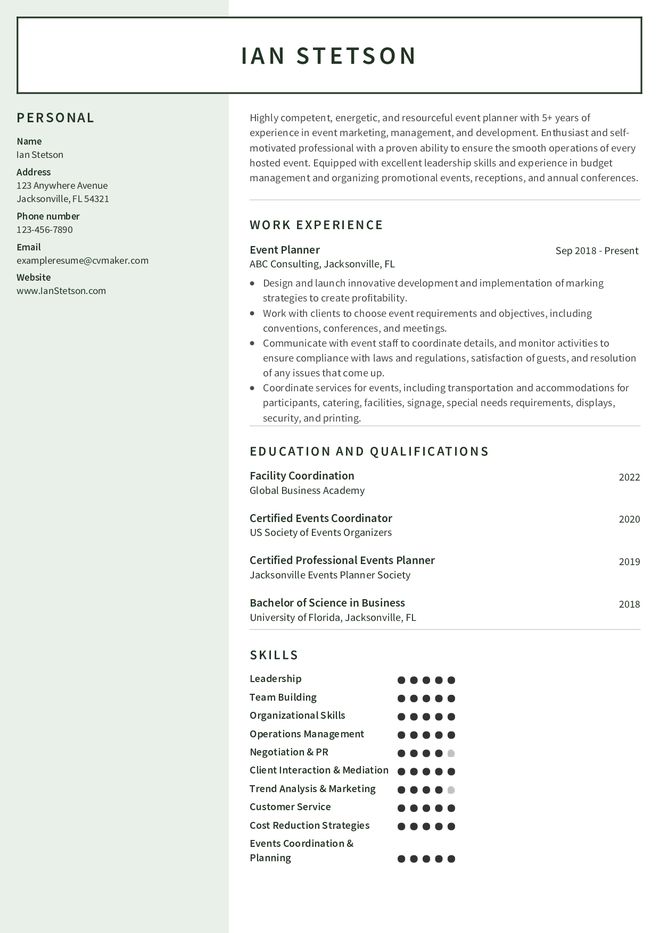
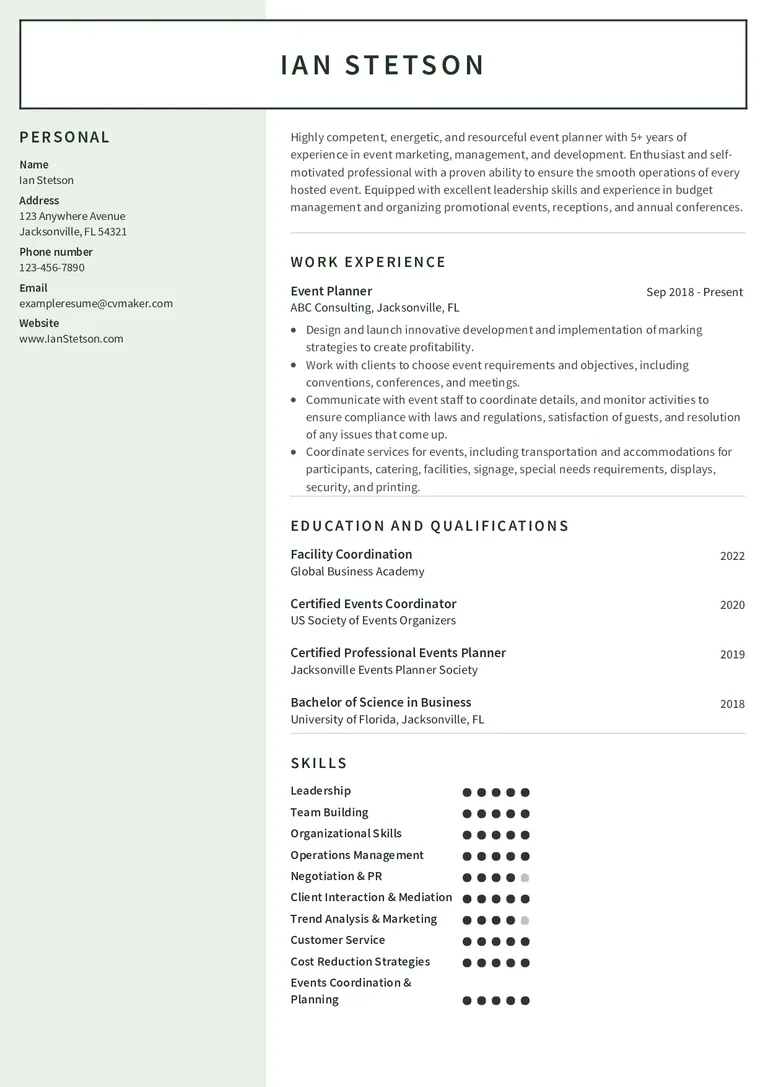
You’ve likely looked at a few event planner resume examples before moving forward to create your own. One of our sample event planner resumes is available above so you can get more insight into how your own resume should look. You’ll see a well-written resume profile, followed by great experience, education, and skill sections. Your own is going to vary but this gives you something to work off of as you continue this guide.
For more layouts and industry samples, compare our resume examples before choosing the format for your own event planner resume.
What to include in an event planner resume: writing tips and examples
For an event planner or event coordinator resume, there are a few things you’ll need to fill out the sections of the resume. First, make sure you have an event planning job description for the resume writing process. Second, bring up your master resume so you can easily dig for what you want to include. Below, we’ll share some information about how to set up some of the most crucial sections of an event planning resume.
How to add contact information to an event planner resume
Place your name, city and state, phone number, professional email address, and a relevant LinkedIn profile or portfolio link at the top. You generally do not need a full street address. Make sure every link and contact detail works before submitting your resume.

Event planner contact details
Alex Morgan
Chicago, IL
(312) 555-0142
linkedin.com/in/alexmorgan
Event coordinator contact details
Taylor Reed
Austin, TX
(512) 555-0136
Portfolio: taylorreed.example.com
How to write an event planner resume summary or objective
Now that you have your event planner job description for a resume, you can move forward. One of the first sections you’ll see is a short professional profile at the top of the page. A resume summary highlights relevant experience and achievements; a resume objective focuses on your career goal and transferable strengths.
One tip we can give you here is that it’s best to write this last. It does come first on the page, but once you apply your skills, education, and experience to the document, you can take part of those and use them for the objective. While you can choose to craft it first, it’s generally easier (and quicker) to leave it until later phases of your resume crafting process.
Keep an event planner resume summary or objective to two to four sentences. Going any longer will make it more challenging to keep the attention of the hiring manager. Use measurable results when you have experience, or relevant training and transferable strengths if you are new to event planning. This is the spot where you start proving you’re the right person for the team.
Use the job description to choose the most relevant event types, responsibilities, and results. The following models are illustrative; replace the numbers and claims with your own verifiable experience.
Event planner resume summary
Event planner with six years of experience coordinating corporate conferences, executive meetings, and product launches. Managed more than 30 events annually with budgets up to $400,000, balancing vendor relationships, logistics, and attendee experience. Recognized for delivering programs on schedule while controlling costs.
Entry-level event planner resume objective
Organized hospitality graduate seeking an event coordinator role with a focus on corporate and community events. Supported campus fundraisers and registration for events with 200+ attendees. Eager to apply scheduling, vendor communication, and problem-solving skills to help deliver seamless events.
Which skills should you include on an event planner resume?
The next thing we want to talk about is event planner resume skills. While you’ll likely share some skills in the experience and objective areas, this section is dedicated to that information. That doesn’t mean you should make a random list and hope for the best, though. Relevant skills are the ones you want to include in this list.
Both soft skills and hard skills are good choices to fill out this section. Things like interpersonal skills and transferable skills can also be used as long as they fit the position you want. For instance, you might want to share that you have attention to detail and great communication skills, as well as knowledge of software and the management aspects of the position.
Every person is going to go about this in a different way. We all have different experiences and education that contribute to the things we are skilled at. However, it can help to jumpstart your list if you have access to commonly used skills. You’ll find several of these below, each of which might be a good choice for your event planner resume.
The secondary article also points to leadership and public relations as useful skills. For an event coordinator resume, choose hands-on skills such as event production, on-site coordination, or supervising event staff only when you can support them with experience.
Event planner resume skills
| Skills for a corporate event planner resume | Skills for an event coordinator resume |
|---|---|
| Conference logistics | Registration management |
| Budget management | Day-of schedules |
| Vendor negotiation | Guest services |
| Stakeholder communication | Vendor coordination |
| Event marketing | Team leadership |
| Project scheduling | Event setup and breakdown |
How to describe work experience on an event planner resume
When you’re sharing experience in event planning on a resume, you need to make sure it’s easy to read and understand. As we’ve mentioned, it’s best only to include relevant information here. Professional experience in a workplace is the best option but you can also share things like volunteering and internships if it fits the needs of the employer.
Under each event planning experience, you want to give the basic details. For each position, list the job title, employer, city and state, and the month and year you started and finished. Leave space under this header and you can include some of your top achievements. This is a great place to quantify your accomplishments and make yourself stand out.
Everything from the way you improved client satisfaction to how you handled a huge conference can be listed here. Use bullet points to make things simple to read. In general, you’ll want to have more points for recent positions than the ones that may be farther in the past. Put these things in reverse-chronological order for the best results.
Begin each bullet with an action verb, describe what you did, and include credible numbers when possible, such as event attendance, budget size, vendor savings, or a satisfaction score. The job title does not have to be identical to the vacancy; internships, volunteer projects, and related hospitality roles can demonstrate the same strengths.
For more guidance on building results-focused entries, read how to write work experience on a resume.
Event planner resume work experience examples
Corporate event planner work experience
Event Planner
Summit Bridge Events | Chicago, IL | March 2022 – Present
Plan and deliver corporate meetings, conferences, and product launches from initial client brief to post-event reporting. Coordinate budgets, venues, suppliers, and event staff while maintaining consistent communication with stakeholders.
Managed logistics for 28 corporate events in one year, serving groups of 80 to 1,200 attendees.
Negotiated venue and vendor contracts that reduced projected event costs by 12% while meeting client requirements.
Created event timelines, staffing plans, and contingency procedures to keep programs on schedule.
Entry-level event coordinator work experience
Volunteer Event Coordinator
Riverside Community Center | Austin, TX | September 2024 – May 2026
Supported community fundraisers and family events by organizing volunteer assignments, handling participant communications, and coordinating event-day setup.
Coordinated registration and check-in for four community events with up to 300 attendees each.
Scheduled 20 volunteers and shared task lists to keep setup and guest services organized.
Worked with local suppliers to confirm deliveries, signage, and catering before each event.
How to list education on an event planner resume
Include your degree or diploma, school, location, and graduation year or expected graduation date. Add relevant coursework, awards, or event-related student projects if they strengthen your application. If you have limited professional experience, you can place education above work experience.
For more detailed formatting advice, read how to include education on a resume.
Examples of education on an event planner resume
Education for an experienced event planner
Bachelor of Science in Hospitality Management
University of Central Florida | Orlando, FL | 2019
Relevant coursework: Event Operations, Hospitality Finance, and Meeting Planning.
Education for an entry-level event coordinator
Bachelor of Arts in Communications (expected May 2027)
University of Texas at Austin | Austin, TX | 2023 – Present
Relevant project: Planned a student-led fundraising event, including vendor outreach, ticketing, and volunteer schedules.
How to list certifications on an event planner resume
Whether you are a wedding planner or skilled with community events, a potential employer wants to see what you’ve invested in becoming the best you can be. One of the ways that many event planners learn new things is by achieving certifications. If you scroll back to our example resume, you can see how this looks for one applicant.
There are numerous ways to attach certifications to resumes. If you have many of them and want to showcase them, consider making a dedicated section for them. Another common option is to list them under your education. List the credential, issuing organization, and year earned. If you have a college degree, you can usually leave high school off your resume. Put them in reverse-chronological order just like you did for your work experience.
Include current, relevant certifications that strengthen your application. If you have a certification that has nothing to do with what this position is about, there’s no need to include it. If it’s somewhat related, you can leave it in. It’s a matter of choosing the ones that will have an impact on what you do on the job.
Use only credentials you have actually earned, and include the issuer and year so employers can verify them.
Examples of certifications on an event planner resume
Meeting planning certification
Certified Meeting Professional (CMP) | Events Industry Council | 2024
Special events certification
Certified Special Events Professional (CSEP) | International Live Events Association | 2023
You know how to fill out the toughest sections of your resume now, so all you have left is to choose a template and make the document gorgeous. CVMaker has a selection of resume templates that work well for event planners. Browse the many options and select one. You can choose between several colors to further customize the resume.
Key takeaways for your event planner resume
Are you ready to take an event planning role where you’re in charge of impressive and amazing events? Having a flawless event planner resume is a huge part of the process so make sure you do your best. When you follow our guide and go through all the steps, you’ll be much more likely to get the interview you want. Good luck!
Extra tips for a stronger event planner resume
At this point, we just have a few extra tips that you can use to ensure a future employer brings you in for your event production skills. Read through the list, make any needed edits, and move forward with a resume you can feel good about.
Remember that the resume is not the only item you need to send in with a job application. It’s also essential to have an event planner cover letter ready to go.
Always read through your resume to find any errors that may have otherwise gone undiscovered. Check for typos and misspellings. Consider using Grammarly or a similar tool for the best results.
Make sure all information in the resume is relevant to this specific position. If that isn’t the case, another pass may be needed to change that.
Reading the resume aloud can give you a better idea of how it flows. Consider a quick read-through of the document after you’ve followed our other tips.
Choose a selection of skills, including a mixture of hard skills and soft skills. This shows how well-rounded you are and indicates you’d be a great addition to the team.
Avoid event-industry jargon or internal shorthand that a recruiter outside your previous organization may not understand.
Next steps?
Coming up to the end of this guide, you have choices about how to create your own resume. One option is to use our resume builder to put things together all on your own. However, we also offer Resume Writing Services that result in a successful execution of this essential document. Work with an expert to make sure your resume really stands out from all the rest.
FAQs
What kind of job responsibilities should I focus on for an event planner resume?
When you have previous experience in event planning, this is something you want to make clear. However, what highlights you list are going to make a difference in whether you seem impressive or not. As with other sections of your event planner resume, you want what you write to be relevant to a specific position.
This is a situation where the job description comes in handy. Look at what is expected of you in the role and choose responsibilities and accomplishments that are similar. Try to stick to things that matter in the new position since other items are not necessarily needed.
How do I describe event planner skills on a resume?
When you’re considering event planning skills for a resume, make sure you peruse the job description. It is going to have insight into key skills that the employer expects you to have. As much as possible, add those skills if you have them. It shows you understand what the job is all about.
Because every job is unique, your list of skills will need to change from one application to the next. As a guideline, choose around six to ten skills that directly match the job description rather than treating ten as a strict limit. If you’re unsure about which skills to choose, scroll back up and look at the common skills we listed earlier to get your brain going.
How should I create an event planner resume with no experience?
If you’re making an entry-level event planner resume, it’s slightly different than a document for someone with experience. In place of experience, you’ll need to talk up your education and skills. Those who have done personal event planning can use that to show what they can do.
You have a choice between a standard reverse-chronological resume or one that focuses more on other things. It’s up to you which is best. But remember that any experience can be listed as long as it somehow relates to the job. Many jobs develop transferable skills, such as scheduling, customer service, or problem-solving. Show how those strengths meet the event planning requirements. Volunteer experiences or internships can also be listed.
What are the rules for an event planner resume summary?
An event planner resume summary and a resume objective serve different purposes: a summary emphasizes experience and results, while an objective focuses on a career goal and relevant strengths. It’s super important as it gives an initial description of who you are and why you should be brought into an interview before being hired for a position.
There are no hard-and-fast rules here, but it’s generally agreed this section should be short. Don’t add more than four sentences. In addition, it’s a good idea to include as many relevant achievements as possible. Education, experience, and skills can be used to flesh out this brief paragraph.
What resume format is best for an event planner?
As you craft your resume, you want to show your skills and experience in event coordination. However, just as important as the words on the page is the format you choose for the document. Using too many colors, fonts, or other features can make it more challenging to read a resume.
You also want to think about how well the different elements work together. Do the fonts and colors look nice together? Have you made sure the hues you used aren’t making it harder to read the document? It’s fine to be creative to a certain point but remember that this is a professional document and it should look like one.
For applications submitted online, use familiar section headings such as Work Experience, Education, and Skills, and avoid formatting that makes essential details hard to locate.
How long should an event planner resume be?
Just like other resumes, most of them for event planners are going to range from one to two pages. Choose the length that presents your strongest, most relevant achievements clearly without unnecessary detail.
Aim for one page if it showcases your qualifications without crowding; use two pages when your relevant experience and results justify the space. Keep every section relevant to the role.
How is an event planner resume different from an event coordinator resume?
Event planners often focus on the event’s scope, budget, client objectives, and vendor selection. Event coordinators may focus more on timelines, vendor confirmations, staffing, and execution on the event day. Event managers may oversee teams or multiple planning functions. Employers use these titles differently, so build your resume around the duties in the specific job description rather than assuming the titles always mean different jobs.
You have all the information you need to make a professional resume that shows off your event planning skills. The final step is to check that your resume is clear, consistent, and easy to scan.
For more resume-writing advice and career resources, explore the CVMaker blog.