Winning Resume Objective Examples & Tips for 2026
Your resume is the first chance you get to make an impression on a potential employer. It allows you to put your best foot forward and highlight why you should get the job.
The first thing a hiring manager will read is your resume objective. Therefore, you must ensure your objective is spot-on and tells the right story about who you are in order to convince the manager to continue reading.
To write a standout resume objective, you need to learn more about what it is. You also need to find out what makes an objective different from a summary, and get some tips and examples to help you as you write your own.
What is a Resume Objective Statement?
One of the most important questions you should have before beginning your resume is, “What is an objective statement?” You need to get a definition to know where to begin.
According to U.S. News and World Report, resume objective statements tell employers who you are, why you want the job, and why they should give you the job over anyone else.
An objective is like a sales pitch. It should always be short and concise. Every word needs a purpose.
You should always customize your objective statement to the specific job for which you are applying. It should act as a targeted statement that positions you as the person to hire for the job. You should not use a generic statement to apply to multiple jobs at different companies. It needs to speak to the specific company and hiring manager to work correctly.
Why Should You Include a Career Objective on a Resume?
A career objective can be a smart addition when your resume needs a bit of context at the top. If you’re new to the workforce, returning after a time away, or changing industries, your experience may not match the job at first glance. An objective helps connect the dots by explaining your target role and the value you bring.
When used well, a career objective can reassure a hiring manager that you’re not just spamming random companies with your resume.
Key Points
A resume objective is most useful when you are:
- Changing fields and your recent experience doesn’t obviously align with the role
- New to the job market and you need to clarify your direction and strengths
- Re-entering the workforce and want to frame your transition in the best way
It reduces confusion by:
- Stating the specific role/job title you’re targeting
- Clarifying that you meant to apply for that specific position and are not sending generic applications
It helps you bridge your background to the role by:
- Briefly showing how your past experience, education, or transferable skills connect to the job you want
- Highlighting the most relevant strengths you bring to the employer
It encourages the hiring manager to keep reading by:
- Letting you make a case for why you’re a strong fit for the job
- Reinforcing your focus and intent when you know exactly what position you want
Resume Objective or Summary Statement: Which Should You Use When?
A resume objective and a summary statement look the same, but they have different purposes. They shouldn’t be used interchangeably. An objective focuses on where you want to go, telling the employer the role you’re targeting and the value you bring. It works best when you’re role-specific and can clearly connect your education, skills, and expertise.
A summary statement focuses on what you bring. It’s a snapshot of your most relevant qualifications, strengths, and achievements. It markets you by highlighting why you’re a strong candidate.
In Short
Resume objective: It’s role-focused, stating that job you want and how you’ll add value
- Best when: you’re targeting a specific position, changing careers, or have limited experience but clear direction
Summary statement: This is based on your qualifications, highlighting relevant skills, experience, and accomplishments
- Best when: you have solid experience and want a fast, high-impact overview of how you fit
What To (and What Not To) Include in a Good Objective for a Resume
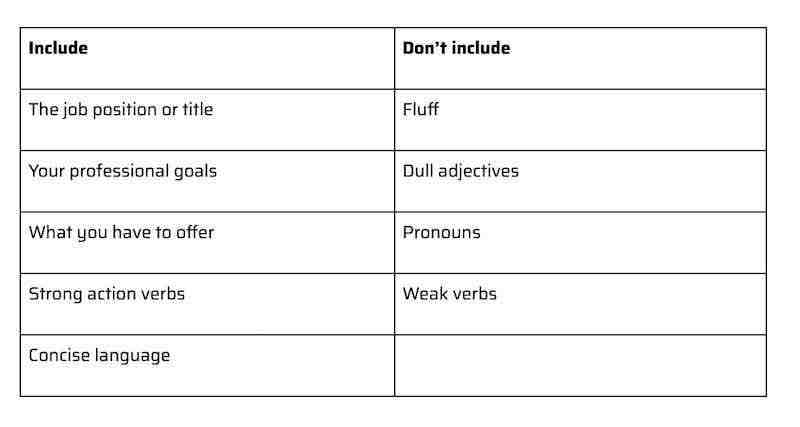
How to Write an Objective for a Resume in 5 Simple Steps
Learning how to write a resume objective may seem simple. After all, good resume objectives are only about 50 words long. However, once you begin working on it, you will see that having such a limited space in which to write makes the task harder.
While you can look over job objective examples to see how to write one, it is better if you follow a step-by-step process. Remember, you won’t just write one objective. You need to write a new one for every resume you send out, so having a precise step-by-step process will help you ensure each one you write is stellar.
Step 1: Read the job description
You need to always look at the job description before starting to think about crafting an objective. The job description will contain important information you need to know to put together a targeted statement.
It is helpful if you take notes as you read. You’ll want to specifically write down key terms the ad uses and pay attention to the requirements so you can note how your experience and skills match up.
Example:
Job description snippet (example):
Notes pulled from the ad (keywords and requirements):
- Keywords: pick/pack, RF scanner, shipping, receiving, cycle counts, WMS
- Requirements: lift 50 lbs, stand long periods, weekends
- Preferred: forklift certification
Step 2: Write your main goal
It doesn’t have to be a beautiful sentence. Just write out what your goal is with this resume. You can go back and spruce it up later.
Because the whole point of the objective is to state your goal, you need to know what this is before you can go any further. Try to customize this goal to the company and position for which you are applying.
Example:
Step 3: State who you are
Now you can write a sentence explaining who you are. You want to give details about relevant skills and experience. Use a sentence or two to connect your background to the job.
Example:
Step 4: Tell them why you are the one to hire
The last thing you need to do is connect everything you’ve said so far to why the hiring manager should look no further and hire you. Let the reader know what you will bring to the table and why you will be of value as an employee.
Example:
Step 5: Edit
Once you have completed the writing, you will probably need to go back over it and tighten it up. Remove any needless words or information. Keep it simple and concise. Do not use flowery language. You want it to read straightforwardly.
Make sure to also check for grammar and spelling errors. Make sure once you finish editing, it reads clearly and makes sense.
Example:
Unedited:
Edited:
Mistakes to Avoid When Writing Objectives for Resumes

There are a few ways your resume objective could go wrong. Since it is the first thing a hiring manager will see and the introduction he or she has to you, it is essential to avoid making mistakes when writing it.
Here’s a look at some of the most common mistakes people make and how to avoid them.
Using the same objective for every resume
It cannot be said enough that you must create a new objective for every single resume you send out. You must have one that matches the job and employer. Even if you apply to one company for multiple positions, you will want a unique objective for each position.
The reason you need a different objective is that it is so specific to the job. You are not just talking about yourself. You are telling the hiring manager why you want this job and why you are a fit for this job.
It is easy to avoid this mistake by simply writing a fresh objective every time you send out a new resume. Learn more about how to tailor your resume for each job application.
Not stating what you will bring to the company
One of the main goals of your objective is to show the hiring manager that you will be an asset. If you fail to state what value you will bring as an employee, your objective fails.
Hiring managers do not want to just hire bodies to fill positions. They want to find people who will bring something to the company and serve to improve it. You need to have value and something unique about you that you can offer that nobody else can.
If you follow the step-by-step process for writing your objective, you shouldn’t have any problems remembering to include this in your statement.
Not proofreading
You cannot write anything and assume it is perfect. You must always read back over anything you write to catch errors. Errors might be grammatical issues or spelling mistakes. These things make your resume look unprofessional.
It may help for you to have someone else read over your objective. Having fresh eyes look at it can help ensure you don’t overlook any issues.
Talking about information not found in your resume
The best objective statement will only be a highlight of what the hiring manager can expect. You won’t explain things in this statement, so the manager needs to be able to look further down on your resume to get additional information.
You should never include anything in the objective that is not elsewhere on your resume. It will be confusing and leave the hiring manager wondering about how truthful you were in your objective.
Make sure you can match all points in your objective to other parts of your resume after you finish writing it.
Writing too much
The objective needs to be short and concise. It should never go over three sentences. Ideally, you want to keep it to 50 words or less.
The hiring manager doesn’t have all the time in the world to read long chunks of text, so you will fail if this is what you present as the first thing on the page. Keep it short and to the point.
It can help if you cut out adjectives and unnecessary words. Play around with it to find different ways to say what you want to say in a shorter way. You may have to adjust things quite a bit, but once you get used to writing objectives, it should become easier to keep the wording tight.
Making no point
If you are writing an objective just because you think you need one, then you probably shouldn’t have one. An objective is only useful when you have a reason for it.
Make sure that there isn’t an alternative way to begin your resume that works better. Never use an objective to fill space or because you think there has to be a blurb at the beginning of your resume.
If you cannot make it through the step-by-step writing process easily, you may not need one in your resume.
11 Strong Resume Objective Examples for Multiple Jobs
Nobody ever said writing a resume objective is easy. It can be tough, even if you know you need to include one.
While the step-by-step process can help make it easier, looking at some examples of the best resume objective statements can be beneficial. Keep in mind that you should use these as inspiration. Do not copy them or try to use them verbatim. Remember, an objective should always be unique to you, the job, and the company, so using someone else’s won’t work.
Engineering: Recent Grad With No Work History
This is a resume objective sample for someone with no work history. It relies on high school accomplishments and knowledge to show fitness for the job. This person is seeking an internship with an engineering company, which is a good fit for his or her skill and experience level. Note that the writer also highlights becoming a valuable member of the team. Since engineering often involves teamwork, this shows the value the person will bring to the company.
Retail: Recent Grad With Experience
This is one of those resume objective samples that broadcasts this person’s energy and enthusiasm for the position. It is clear this recent high school grad is passionate about fashion and has skills that could be very beneficial to the employer. Read more in the high school resume example and writing guide.
Science: Entry-Level Researcher
The writer here highlights his or her experience, which relates to the job. The person also mentions the entry-level aspect of the job, which helps ensure the hiring manager knows the person knows about this aspect of the job. This is important if this applicant has experience in the field. The hiring manager could think this was a mistake, and that the person meant to apply for another position.
Read our tips on how to write a resume with little to no experience for more inspiration.
Art: Gallery Exhibition
A creative field requires a bit more of a flourish in the objective statement. This is a perfect example of strong language and professionalism. The writer makes it clear what he or she has to offer and what he or she desires.
Fortune 500 Companies: Executive Level
Here is someone who has plenty of experience and a good skill base looking to move up even more in his or her career. By reading this, it is easy to see this person is driven to be successful and wants to help the company do better.
Social Services: Interpreter
It is clear from this objective this writer has strong language skills and wants to help people. He or she wants to work as a German/English interpreter and has the background to support that. It will be very clear to the hiring manager this person is worth considering for the position.
Aviation: Entry-Level Aircraft Maintenance Technician
This objective is clear about the job target and fits someone early in their career. It emphasizes safety, accuracy, and teamwork, which are all priorities in aviation, while showing the candidate understands the importance of procedures and documentation.
Warehouse: Warehouse Associate
This works well for someone at entry-level or who already works in a general warehouse role because it highlights consistency and process-following. It also speaks directly to what employers need most, which is accuracy, speed, and safe performance.
Lab Technician: Quality Control
This focuses on reliability and process discipline, and both are important in lab settings. The candidate also signals comfort with documentation and procedures, helping the hiring manager trust their work will be consistent and always ready for an audit.
Career Re-entry: Stay-at-Home Mom Returning to the Workforce
This will help provide context for a career gap without overexplaining it. It positions the candidate as capable and intentional, while translating real-world responsibilities into workplace strengths employers recognize.
Manufacturing Engineering
The above is effective for a mid-to-senior candidate because it emphasizes business outcomes and improvement methods. It also signals the candidate’s ability to work across teams, which is essential for implementing changes on the production floor.
Accounts Receivable
This objective clearly targets AR and highlights the responsibilities that matter most in that type of role. It also shows the candidate understands both the customer-facing side (disputes) and the internal side (reconciliation and close).
School Psychology: Graduate Intern
Graduate student in school psychology seeking a school psychology intern placement to support student learning and well-being through assessment, data-driven intervention, and collaboration with staff and families. Brings strong report-writing skills, professionalism, and a student-centered approach,with a commitment to ethical practice and continuous learning.
This objective statement works well for an internship because it clearly states the training level while highlighting core responsibilities of the role. It also emphasizes collaboration and ethical practice, both of which are essential in school psychology.
Final Points on Career Objective Examples and Writing

A resume objective is not a requirement for every resume, but it can help you land the job in the right situation. When you know what you want and have clear professional goals, an objective can enable you to sell yourself to a hiring manager in a clear and concise way.
Writing an objective statement requires knowing your main goal and the reason why you want the job, understanding the job description, and crafting a few sentences explaining why you are the best choice for the position. It requires specific language that is unique to each employer and position for which you apply.
When you put together a solid resume objective, you can elevate yourself above other applicants and increase your chances of getting an interview.
FAQs on Resume Objectives
Before you go, here is a look at some of the common questions people have about resume objectives. These cover a few extra points that you may need to know.
1. What is a good objective for a resume with no experience?
If you have no prior work experience, you are likely applying to a job that doesn’t require any. You should start with the mindset that you are competing with others in your same situation.
The objective examples for resumes above give a few ideas you can use. Focus on the things about you and the skills you have that will work for the job. This should allow you to create a winning objective.
2. What can I put on my resume instead of an objective?
You don’t have to use an objective, and you shouldn’t use one if it doesn’t suit your needs. An alternative is a summary statement, which is like a synopsis of your resume. You also could jump straight into a list of your skills, or you could use nothing. Do what works best in your situation and for your needs.
3. What is your objective as a student?
The objective for resume examples show a couple for students. Your objective at this stage in life may be to find part-time employment, a job that will work around your school schedule, or a position close to campus.
You should figure out what your main goal is and find a way to work that into the objective statement in your resume. However, it is really important to ensure you show why you are valuable to the company and not only focus on why you want this specific job.
Check out the student resume example and writing guide for more tips.
4. How do you write an objective for a part-time job?
When seeking part-time employment, you want to approach the objective the same way you would for a full-time job. Nothing should change about your approach with the exception that you might want to mention part-time in the statement to reassure the hiring manager you understand this is not a full-time position.